No Data
No Data
No Data
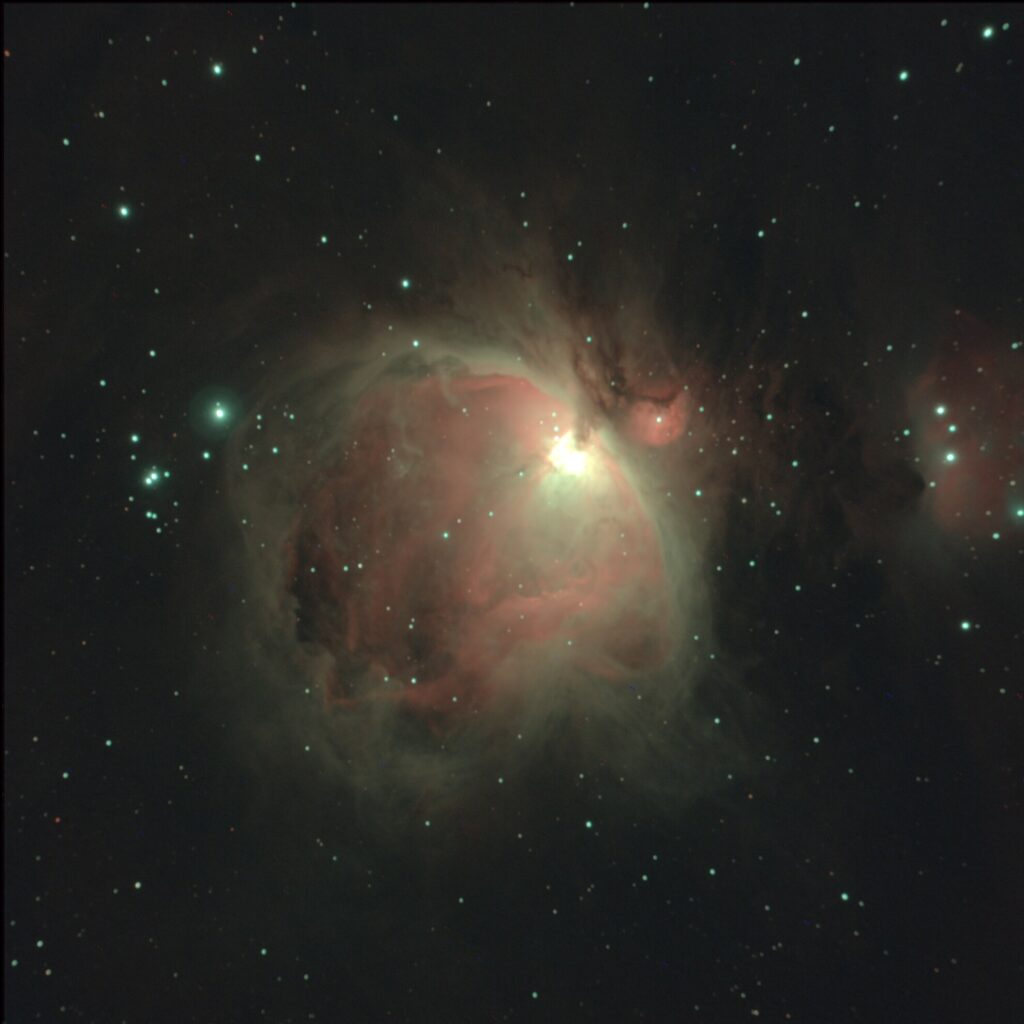
The Orion Nebula (also known as Messier 42, SH 2-281, M42, or NGC 1976) is a diffuse nebula in the Milky Way situated south of Orion’s Belt in the constellation of Orion, and is known as the middle “star” in the “sword” of Orion. It is one of the brightest nebulae and is visible to the naked eye in the night sky with an apparent magnitude of 4.0. It is 1,267.0 ± 5.4 light-years (388.5 ± 1.7 pc) away and is the closest region of massive star formation to Earth. M42 is estimated to be 25 light-years across (so its apparent size from Earth is approximately 1 degree). It has a mass of about 2,000 times that of the Sun. Older texts frequently refer to the Orion Nebula as the Great Nebula in Orion or the Great Orion Nebula.
The Orion Nebula is one of the most scrutinized and photographed objects in the night sky and is among the most intensely studied celestial features. The nebula has revealed much about the process of how stars and planetary systems are formed from collapsing clouds of gas and dust. Astronomers have directly observed protoplanetary disks and brown dwarfs within the nebula, intense and turbulent motions of the gas, and the photo-ionizing effects of massive nearby stars in the nebula.
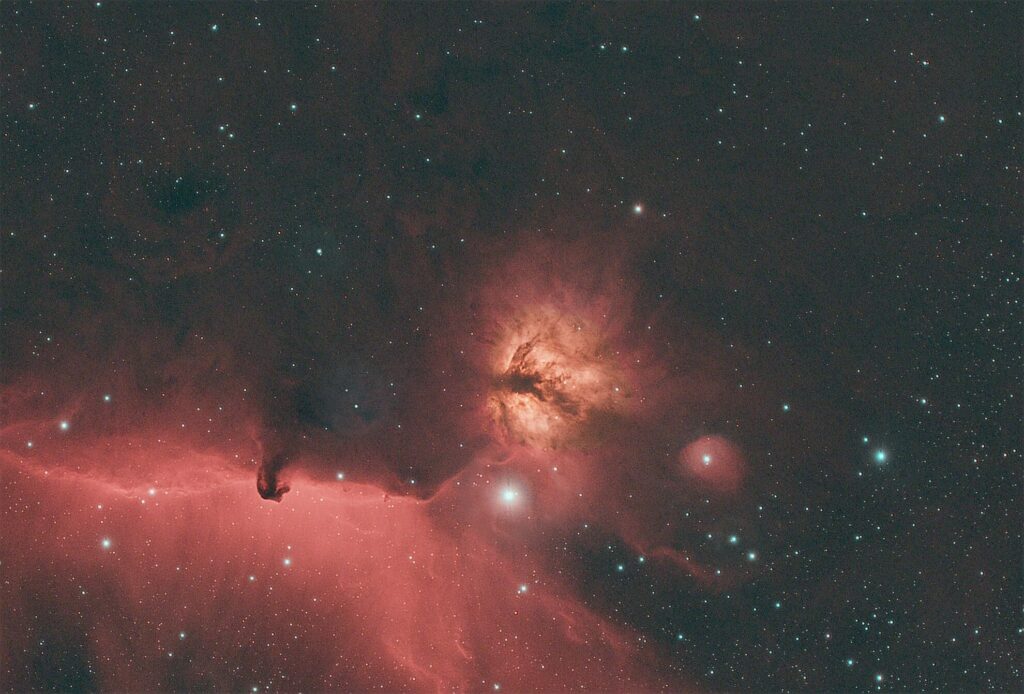
The Flame Nebula, designated as NGC 2024 and Sh2-277, is an emission nebula in the constellation Orion. It is about 1350 light-years away. At that distance, the Flame Nebula lies within the Orion B cloud of the larger Orion Molecular Cloud Complex.
The bright star Alnitak (ζ Ori), the easternmost star in the Belt of Orion, appears very close to the Flame Nebula in the sky. But the star and nebula are not physically associated with one another. The Flame Nebula contains a young cluster of stars which includes at least one hot, luminous O-type star labeled IRS 2b. The dense gas and dust in the foreground of the nebula heavily obscures the star cluster inside the nebula, making studies at infrared wavelengths most useful.
The energetic ultraviolet light emitted by the central O-type star IRS 2b into the Flame Nebula causes the gas to be excited and heated. The glow of the nebula results from the energy input from this central star. Within the nebula and surrounding the central hot star is a cluster of young, lower-mass stars, 86% of which have circumstellar disks. X-ray observations by the Chandra X-ray Observatory show several hundred young stars, out of an estimated population of 800 stars. X-ray and infrared images indicate that the young stars are concentrated near the center of the cluster.
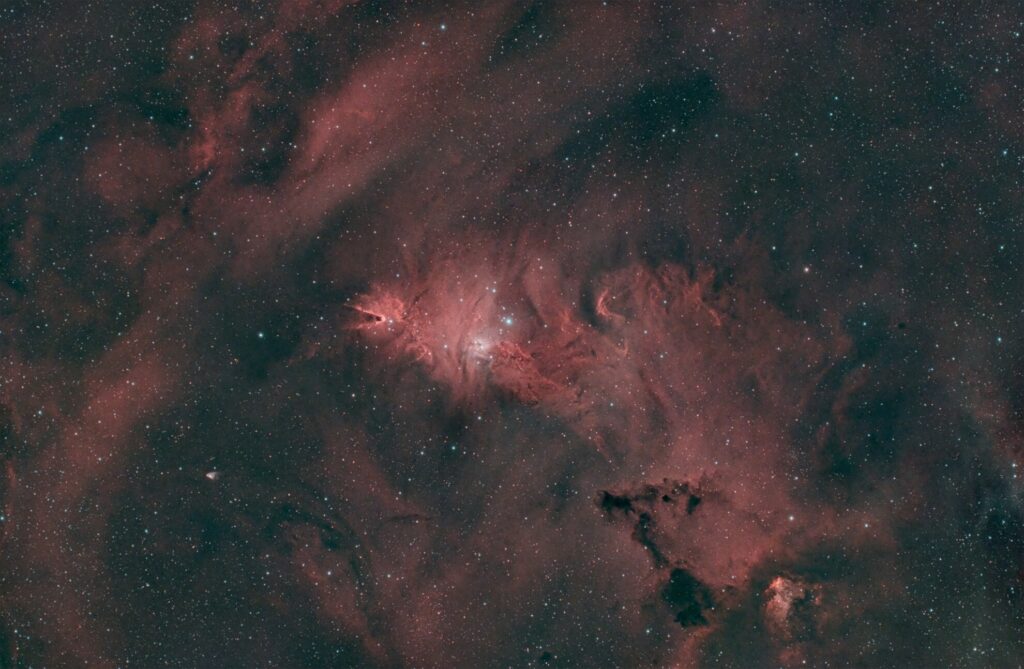
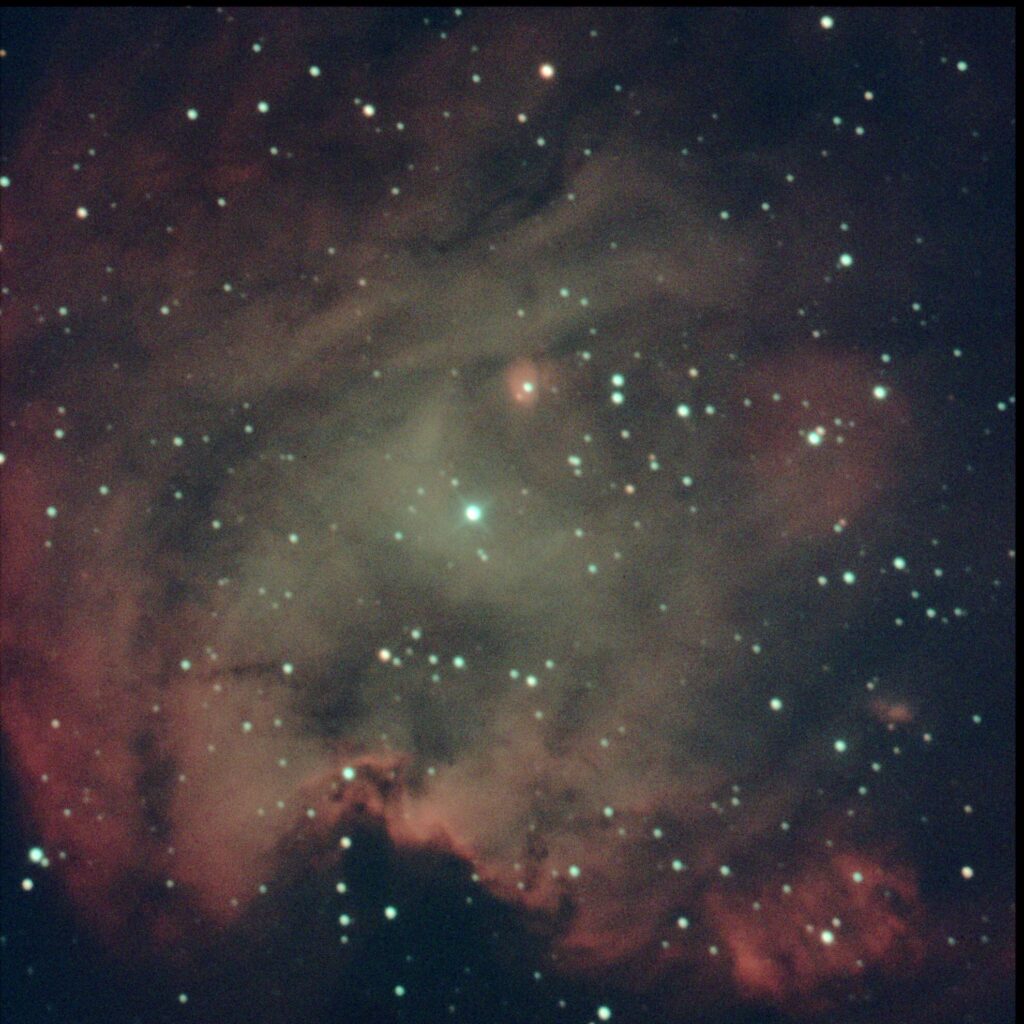
NGC 2264 or SH 2-273 is the location where the Cone Nebula, the Stellar Snowflake Cluster and the Christmas Tree Cluster have formed in this emission nebula. For reference, the Stellar Snowflake Cluster is located 2,700 light years away in the constellation Monoceros.
The Snowflake Cluster was granted its name due to its unmistakable pinwheel-like shape and its assortment of bright colors. The Christmas Tree star formation consists of young stars obscured by heavy layers of dust clouds. These dust clouds, along with hydrogen and helium are producing luminous new stars. The combination of dense clouds and an array of colors creates a color map filled with varying wavelengths. As seen in the photographs taken by the Spitzer Space telescope, we are able to differentiate between young red stars and older blue stars.
No Data
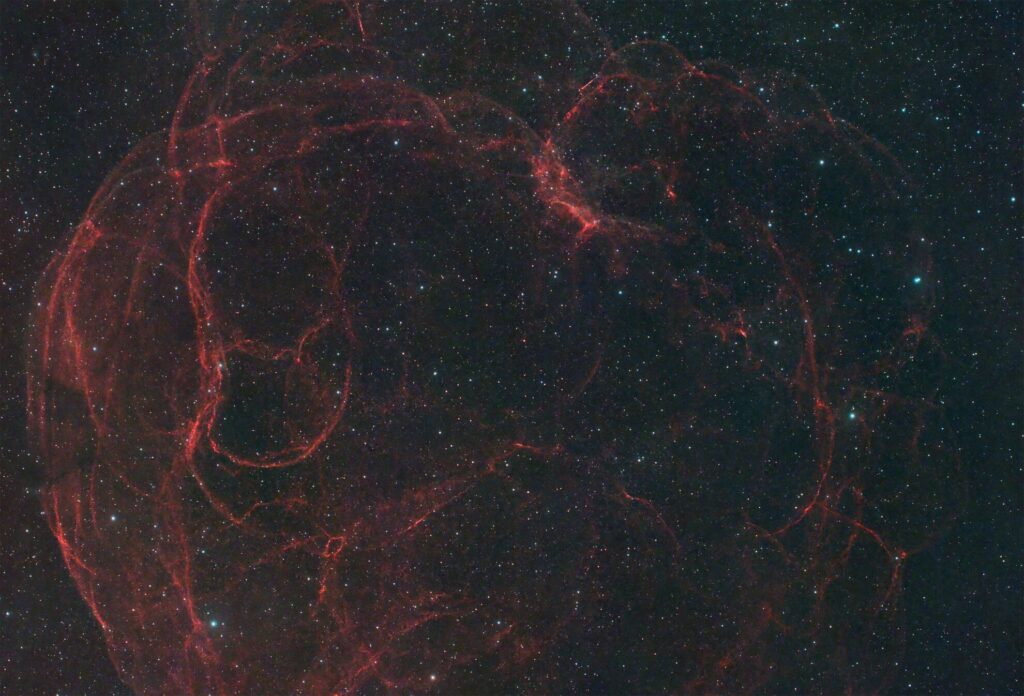
Simeis 147, also known as the Spaghetti Nebula, SNR G180.0-01.7 or Sharpless 2-240, is a supernova remnant (SNR) in the Milky Way, straddling the border between the constellations Auriga and Taurus. It was discovered in 1952 at the Crimean Astrophysical Observatory by Grigory Shajn and his team using a Schmidt camera and a narrowband filter close to the Hydrogen Alpha transmission line. It is difficult to observe due to its extremely low surface brightness. This discovery was part of a survey conducted between 1945 and 1955, most likely using captured German equipment, as the observatory was practically destroyed during WWII. The Schmidt camera had a field of view of 175′. Many previously unknown hydrogen nebula were discovered this way, as they are not readily visible in regular photographs.
The nebulous area has an almost spherical shell and a filamentary structure. The remnant has an apparent diameter of approximately 3 degrees, an estimated distance of approximately 3000 (±350) light-years, and an age of approximately 40,000 years. At that distance, it spans roughly 160 lightyears.
It is believed that the stellar explosion left behind a rapidly spinning neutron star known as pulsar PSR J0538+2817 in the nebula core, emitting a strong radio signal.
No Data
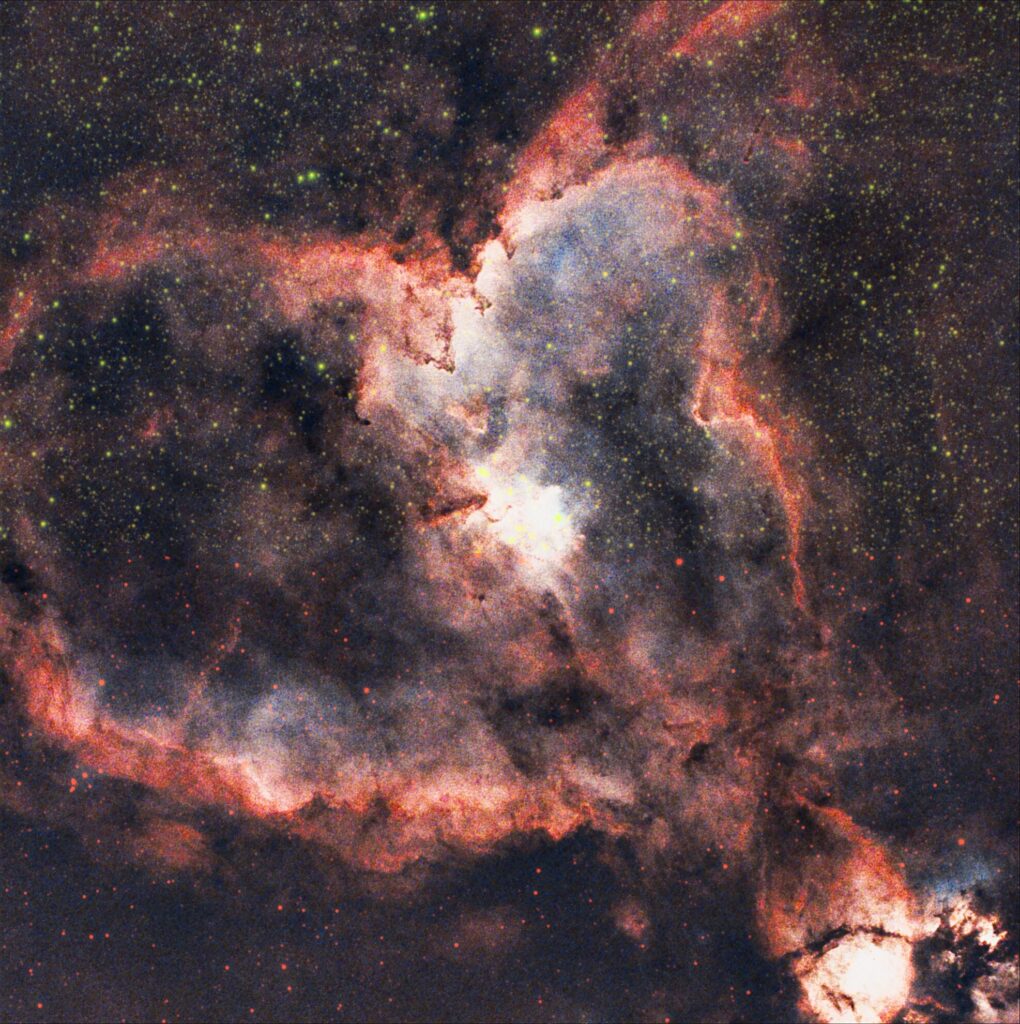
The Heart Nebula (also known as the Running Dog Nebula, Sharpless 2-190) is an emission nebula, 7,500 light-years (2,300 pc) away from Earth and located in the Perseus Arm of the Galaxy in the constellation Cassiopeia. It was discovered by William Herschel on 3 November 1787. In 1958, it was identified as a radio source by Gart Westerhout and is therefore also referred to as Westerhout 4 (or W4). It displays glowing ionized hydrogen gas and darker dust lanes.
The brightest part of the nebula (a knot at its western edge) is separately classified as NGC 896, because it was the first part of the nebula to be discovered. The nebula’s intense red output and its morphology are driven by the radiation emanating from a small group of hot stars near the nebula’s center. This open cluster of stars, known as Collinder 26, Melotte 15, or IC 1805, contains a few bright stars nearly 50 times the mass of the Sun, and many more dim stars that are only a fraction of the Solar mass.
The Heart Nebula is also made up of ionized oxygen and sulfur gasses, which are responsible for the rich blue and orange colors seen in narrowband images. The nebula also spans almost 2 degrees in the sky, covering an area four times that of the diameter of the full moon.
The Heart Nebula belongs to a larger structure known as the W3/W4/W5 complex. It is also the brightest part of a superbubble known as the W4 superbubble , sometimes referred to as the W4 chimney, as it is believed that hot gas is transferred from the galactic disk to the halo through this structure.
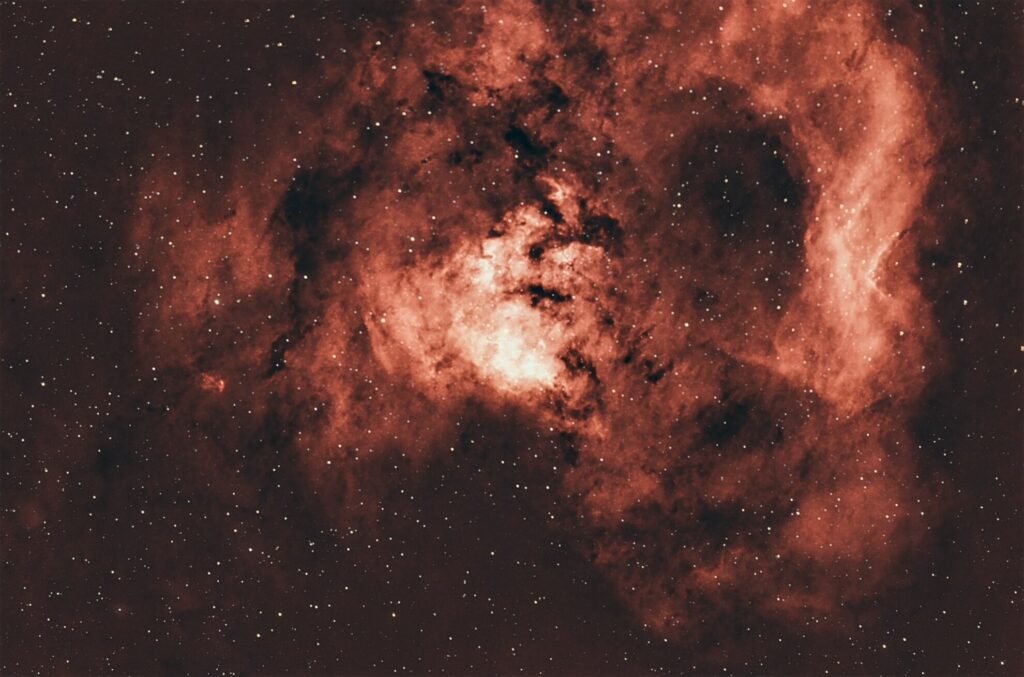
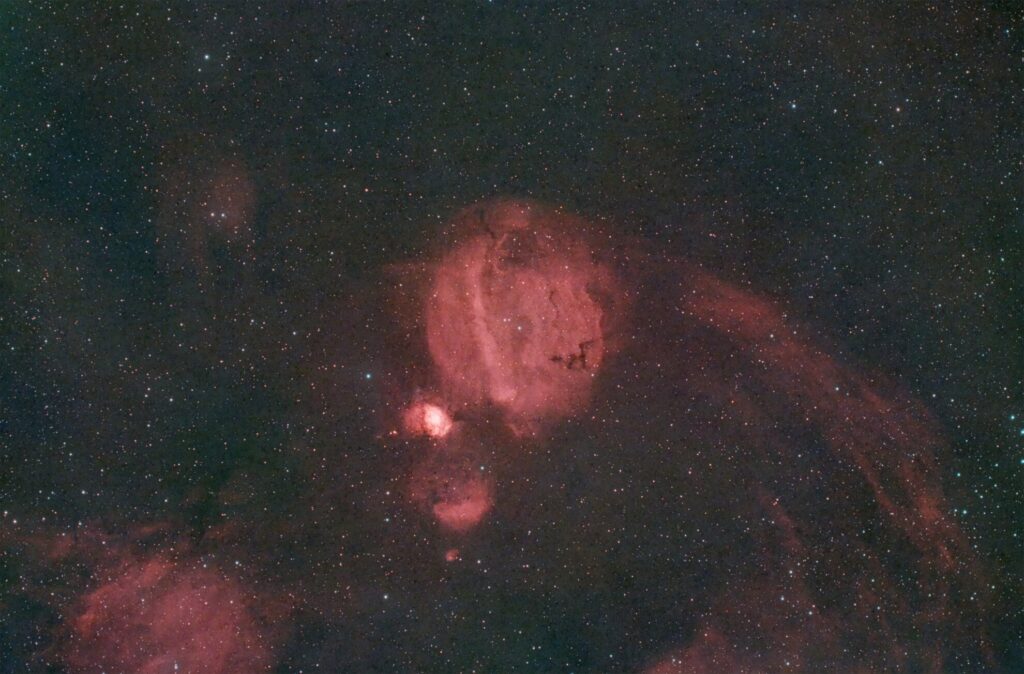
NGC 7822, also known as the Question Mark Nebula, is a young star forming complex in the constellation of Cepheus. The complex encompasses the emission region designated Sharpless 171, and the young cluster of stars named Berkeley 59. The complex is believed to be some 800–1000 pc distant, with the younger components aged no more than a few million years. The complex also includes one of the hottest stars discovered within 1 kpc of the Sun, namely BD+66 1673, which is an eclipsing binary system consisting of an O5V that exhibits a surface temperature of nearly 45,000 K and a luminosity about 100,000 times that of the Sun. The star is one of the primary sources illuminating the nebula and shaping the complex’s famed pillars of creation-type formations, the elephant trunks.