Category: Astrophotos

  • SH 2-157

    M109 2024-06-14

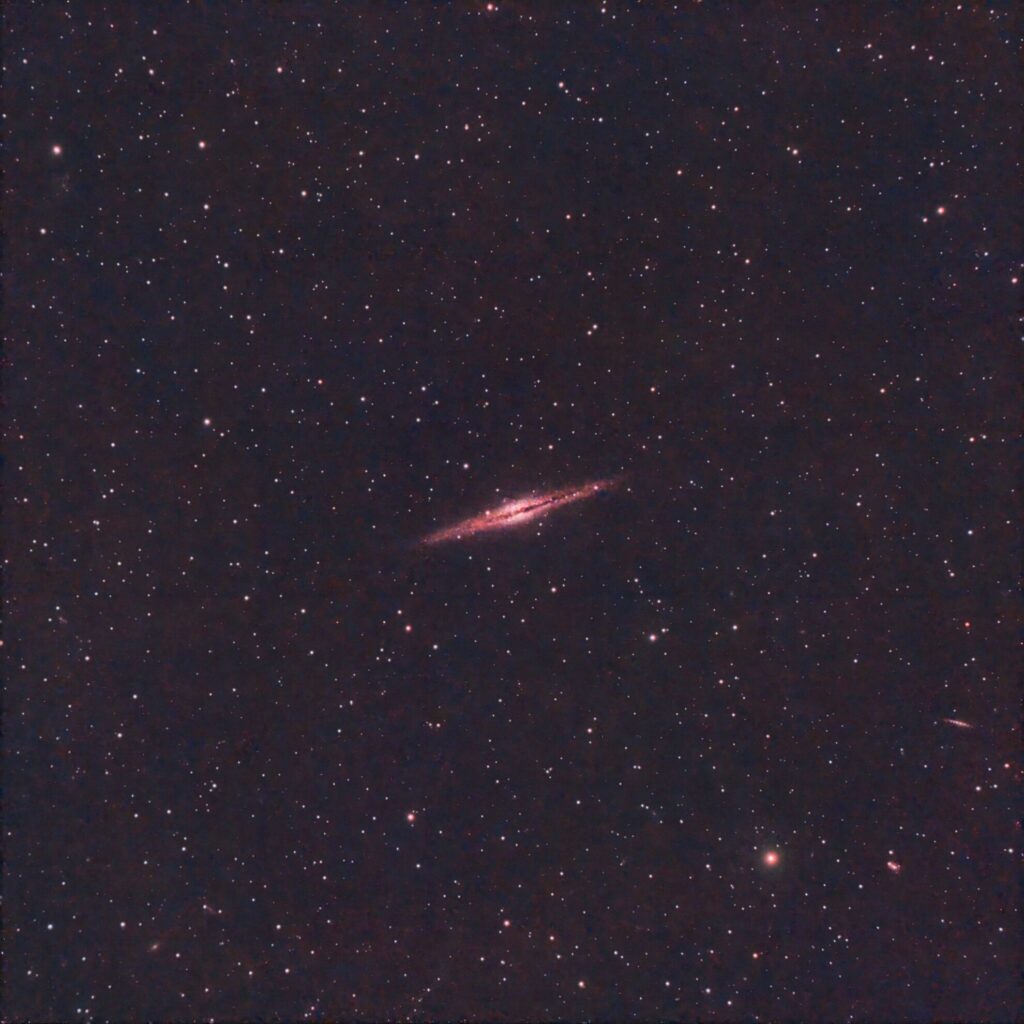
    NGC 891 (also known as Caldwell 23, the Silver Sliver Galaxy, and the Outer Limits Galaxy) is an edge-on unbarred spiral galaxy about 30 million light-years away in the constellation Andromeda. It was discovered by William Herschel on October 6, 1784. The galaxy is a member of the NGC 1023 group of galaxies in the Local Supercluster. It has an H II nucleus.

    The object is visible in small to moderate size telescopes as a faint elongated smear of light with a dust lane visible in larger apertures.

    In 1999, the Hubble Space Telescope imaged NGC 891 in infrared.

    In 2005, due to its attractiveness and scientific interest, NGC 891 was selected to be the first light image of the Large Binocular Telescope. In 2012, it was again used as a first light image of the Lowell Discovery Telescope with the Large Monolithic Imager.

    Supernova SN 1986J was discovered on August 21, 1986 at apparent magnitude 14.

  • SH 2-132

    M109 2024-06-14

    NGC 891 (also known as Caldwell 23, the Silver Sliver Galaxy, and the Outer Limits Galaxy) is an edge-on unbarred spiral galaxy about 30 million light-years away in the constellation Andromeda. It was discovered by William Herschel on October 6, 1784. The galaxy is a member of the NGC 1023 group of galaxies in the Local Supercluster. It has an H II nucleus.

    The object is visible in small to moderate size telescopes as a faint elongated smear of light with a dust lane visible in larger apertures.

    In 1999, the Hubble Space Telescope imaged NGC 891 in infrared.

    In 2005, due to its attractiveness and scientific interest, NGC 891 was selected to be the first light image of the Large Binocular Telescope. In 2012, it was again used as a first light image of the Lowell Discovery Telescope with the Large Monolithic Imager.

    Supernova SN 1986J was discovered on August 21, 1986 at apparent magnitude 14.

  • SH 2-45

    M109 2024-06-14

    NGC 891 (also known as Caldwell 23, the Silver Sliver Galaxy, and the Outer Limits Galaxy) is an edge-on unbarred spiral galaxy about 30 million light-years away in the constellation Andromeda. It was discovered by William Herschel on October 6, 1784. The galaxy is a member of the NGC 1023 group of galaxies in the Local Supercluster. It has an H II nucleus.

    The object is visible in small to moderate size telescopes as a faint elongated smear of light with a dust lane visible in larger apertures.

    In 1999, the Hubble Space Telescope imaged NGC 891 in infrared.

    In 2005, due to its attractiveness and scientific interest, NGC 891 was selected to be the first light image of the Large Binocular Telescope. In 2012, it was again used as a first light image of the Lowell Discovery Telescope with the Large Monolithic Imager.

    Supernova SN 1986J was discovered on August 21, 1986 at apparent magnitude 14.

  • SH 1-157

    SH1-157 53×180 2025-12-19

    No Data

  • NGC 7635

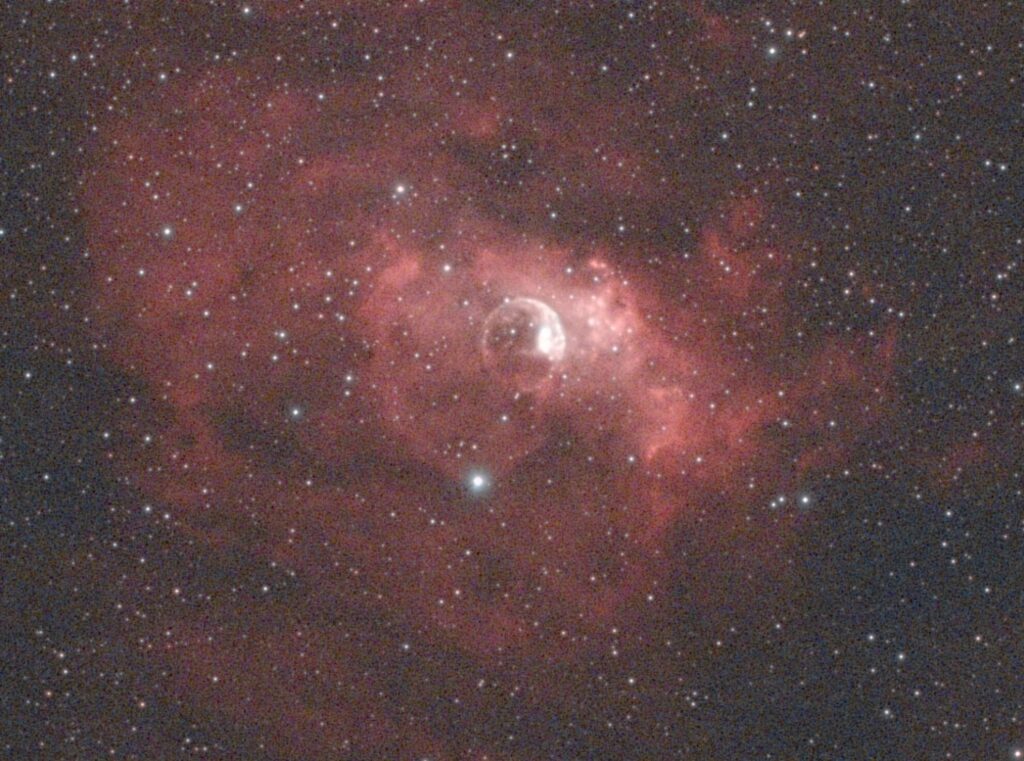
    NGC 7635 Bubble Nebula 52×180 2025-09-10

    The Bubble Nebula, also known as NGC 7635Sharpless 162, or Caldwell 11, is an H II region emission nebula in the constellation Cassiopeia. It lies close to the open cluster Messier 52. The “bubble” is created by the stellar wind from a massive hot, 8.7 magnitude young central star, SAO 20575 (BD+60°2522). The nebula is near a giant molecular cloud which contains the expansion of the bubble nebula while itself being excited by the hot central star, causing it to glow. It was discovered in November 1787 by William Herschel. The star BD+60°2522 is thought to have a mass of about 44. 

  • NGC 7331

    NGC7331

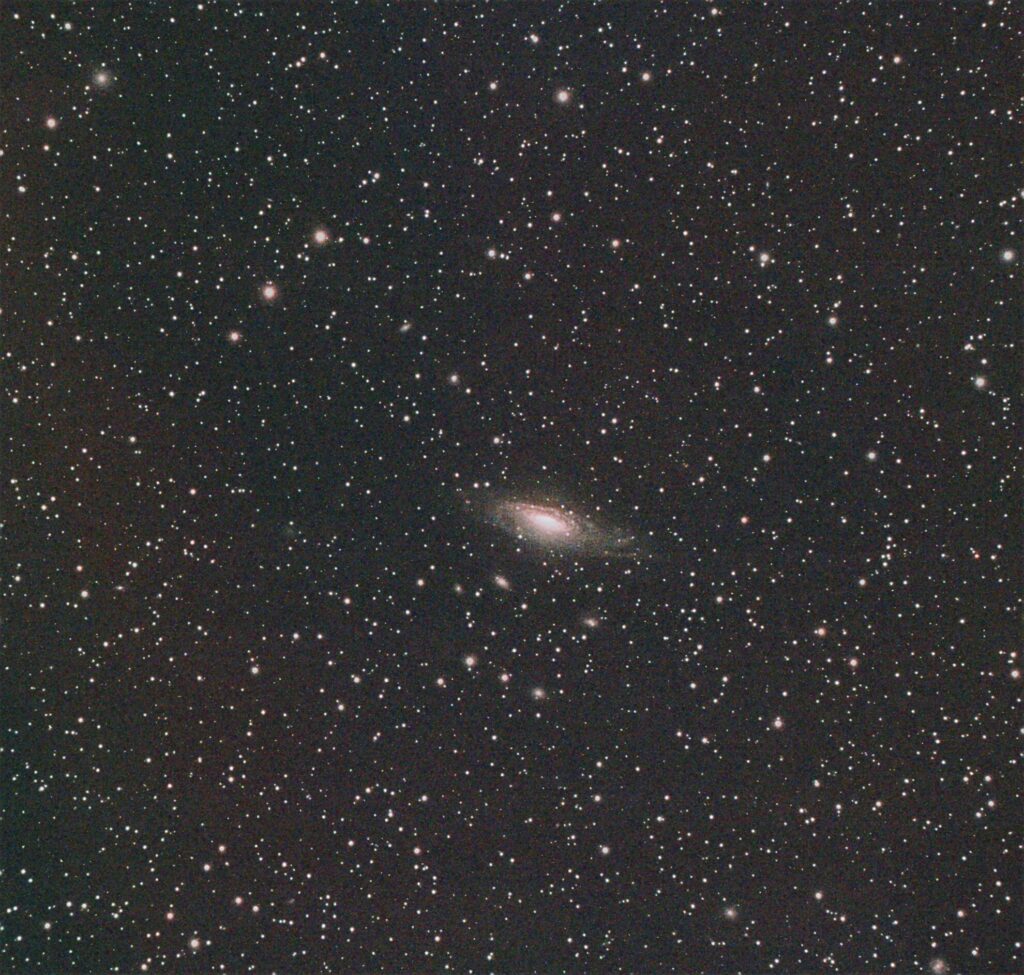
    NGC 7331, also known as Caldwell 30, is an unbarred spiral galaxy about 13.427 megaparsecs (43.79 million light-years) away in the constellation Pegasus. It was discovered by William Herschel on 6 September 1784.

    The galaxy appears similar almost in size and structure to the Milky Way, and is sometimes referred to as “the Milky Way’s twin”. However, discoveries in the 2000s regarding the structure of the Milky Way may call this similarity into doubt, particularly because the latter is now believed to be a barred spiral, compared to the unbarred status of NGC 7331. In spiral galaxies the central bulge typically co-rotates with the disk but the bulge in the galaxy NGC 7331 is rotating in the opposite direction to the rest of the disk. In both visible light and infrared photos of the NGC 7331, the core of the galaxy appears to be slightly off-center, with one side of the disk appearing to extend further away from the core than the opposite side.

  • NGC 7000

    NGC7000-North American Nebula

    The North America Nebula (NGC 7000 or Caldwell 20) is an emission nebula in the constellation Cygnus, close to Deneb (the tail of the swan and its brightest star) in the night sky. It is named because its shape resembles North America.

  • NGC 6992

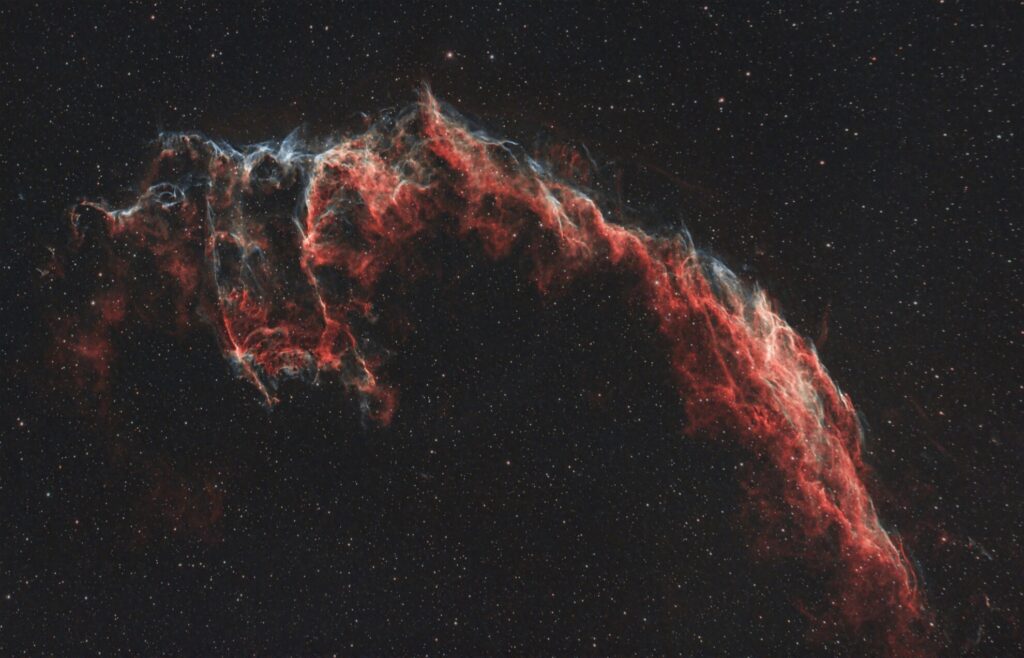
    NGC 6992 Eastern Vail Nebula 2025-08-10

    The Veil Nebula is a cloud of heated and ionized gas and dust in the constellation Cygnus.

    It constitutes the brightest parts of the visible portion of the Cygnus Loop, a supernova remnant, many portions of which have acquired their own individual names and catalogue identifiers. The source supernova was a star 20 times more massive than the Sun which exploded between 10,000 and 20,000 years ago. At the time of the explosion, the supernova would have appeared brighter than Venus in the sky, and visible in the daytime. The remnants have since expanded to cover an area of the sky roughly 3 degrees in diameter (about 6 times the diameter, and 36 times the area, of the full Moon). While previous distance estimates have ranged from 1,200 to 5,800 light-years, a 2018 determination of 2,400 light-years is based on direct astrometric measurements. (The distance estimates affect also the estimates of size and age.)

    The Hubble Space Telescope captured several images of the nebula. The analysis of the emissions from the nebula indicates the presence of oxygensulfur, and hydrogen. The Cygnus Loop is also a strong emitter of radio waves and x-rays.

  • NGC 6960

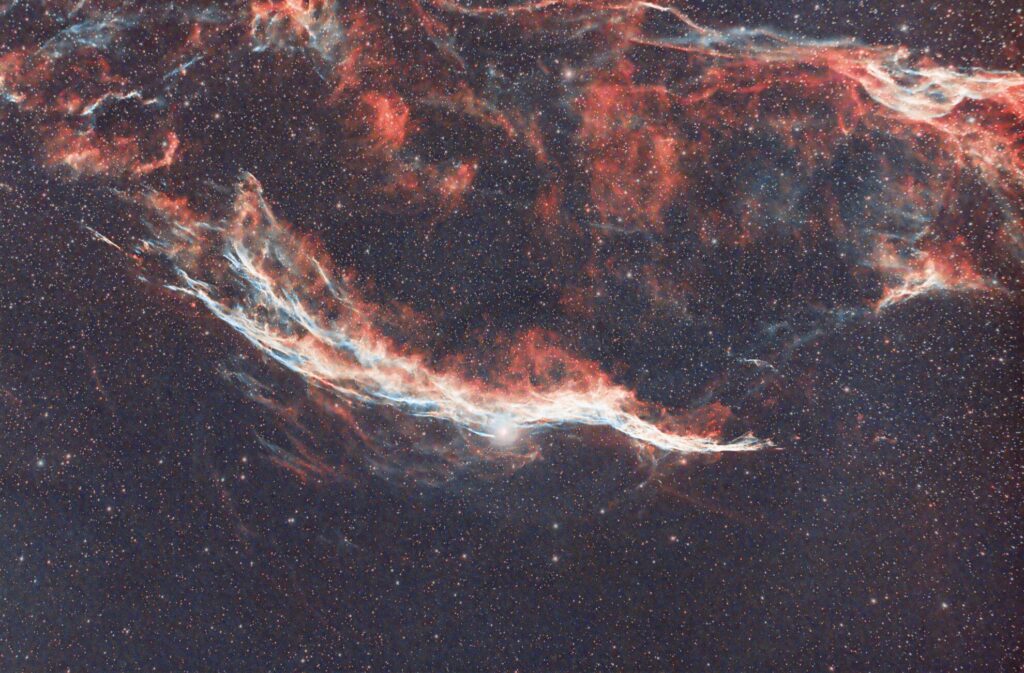
    NGC6960 Western Veil Nebula 2025-08-11

    The Veil Nebula is a cloud of heated and ionized gas and dust in the constellation Cygnus.

    It constitutes the brightest parts of the visible portion of the Cygnus Loop, a supernova remnant, many portions of which have acquired their own individual names and catalogue identifiers. The source supernova was a star 20 times more massive than the Sun which exploded between 10,000 and 20,000 years ago.[ At the time of the explosion, the supernova would have appeared brighter than Venus in the sky, and visible in the daytime. The remnants have since expanded to cover an area of the sky roughly 3 degrees in diameter (about 6 times the diameter, and 36 times the area, of the full Moon). While previous distance estimates have ranged from 1,200 to 5,800 light-years, a 2018 determination of 2,400 light-years is based on direct astrometric measurements. (The distance estimates affect also the estimates of size and age.)

    The Hubble Space Telescope captured several images of the nebula. The analysis of the emissions from the nebula indicates the presence of oxygensulfur, and hydrogen. The Cygnus Loop is also a strong emitter of radio waves and x-rays.

  • NGC 6946

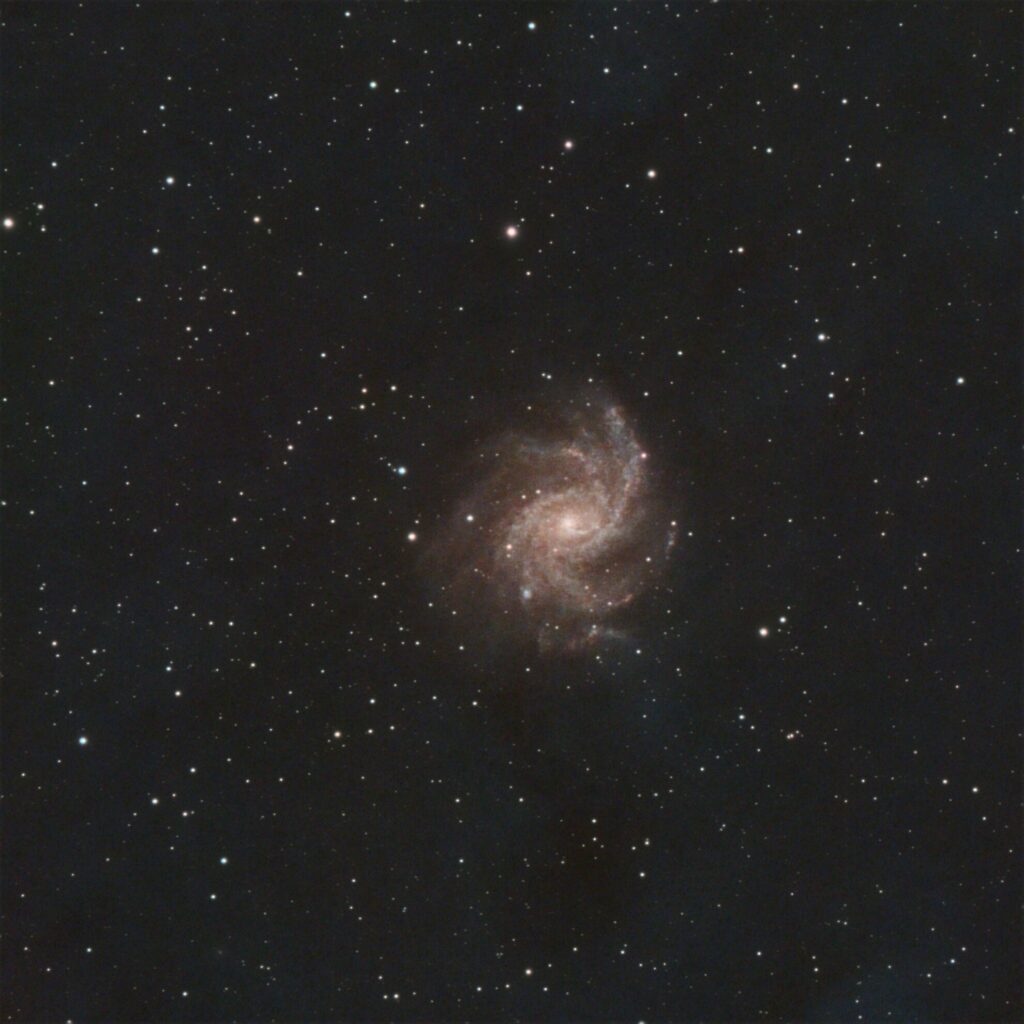
    NGC 6946 Fireworks Galaxy

    NGC 6946, sometimes referred to as the Fireworks Galaxy, is a grand design, face-on intermediate spiral galaxy with a small bright nucleus, whose location in the sky straddles the boundary between the northern constellations of Cepheus and Cygnus. Its distance from Earth is about 25.2 million light-years or 7.72 megaparsecs, similar to the distance of M101 (NGC 5457) in the constellation Ursa Major. Both were once considered to be part of the Local Group, but are now known to be among the dozen bright spiral galaxies near the Milky Way but beyond the confines of the Local Group. NGC 6946 lies within the Virgo Supercluster.

    The galaxy was discovered by William Herschel on 9 September 1798. Based on an estimation by the Third Reference Catalogue of Bright Galaxies (RC3) in 1991, the galaxy has a D25 B-band isophotal diameter of 26.77 kiloparsecs (87,300 light-years). It is heavily obscured by interstellar matter due to its location close to the galactic plane of the Milky Way. Due to its prodigious star formation it has been classified as an active starburst galaxy. NGC 6946 has also been classified as a double-barred spiral galaxy, with the inner, smaller bar presumably responsible for funneling gas into its center.

    Various unusual celestial objects have been observed within NGC 6946. This includes the so-called ‘Red Ellipse’ along one of the northern arms that looks like a super-bubble or very large supernova remnant, and which may have been formed by an open cluster containing massive stars. There are also two regions of unusual dark lanes of nebulosity, while within the spiral arms several regions appear devoid of stars and gaseous hydrogen, some spanning up to two kiloparsecs across. A third peculiar object, discovered in 1967, is now known as “Hodge’s Complex”. This was once thought to be a young supergiant cluster, but in 2017 it was conjectured to be an interacting dwarf galaxy superimposed on NGC 6946.