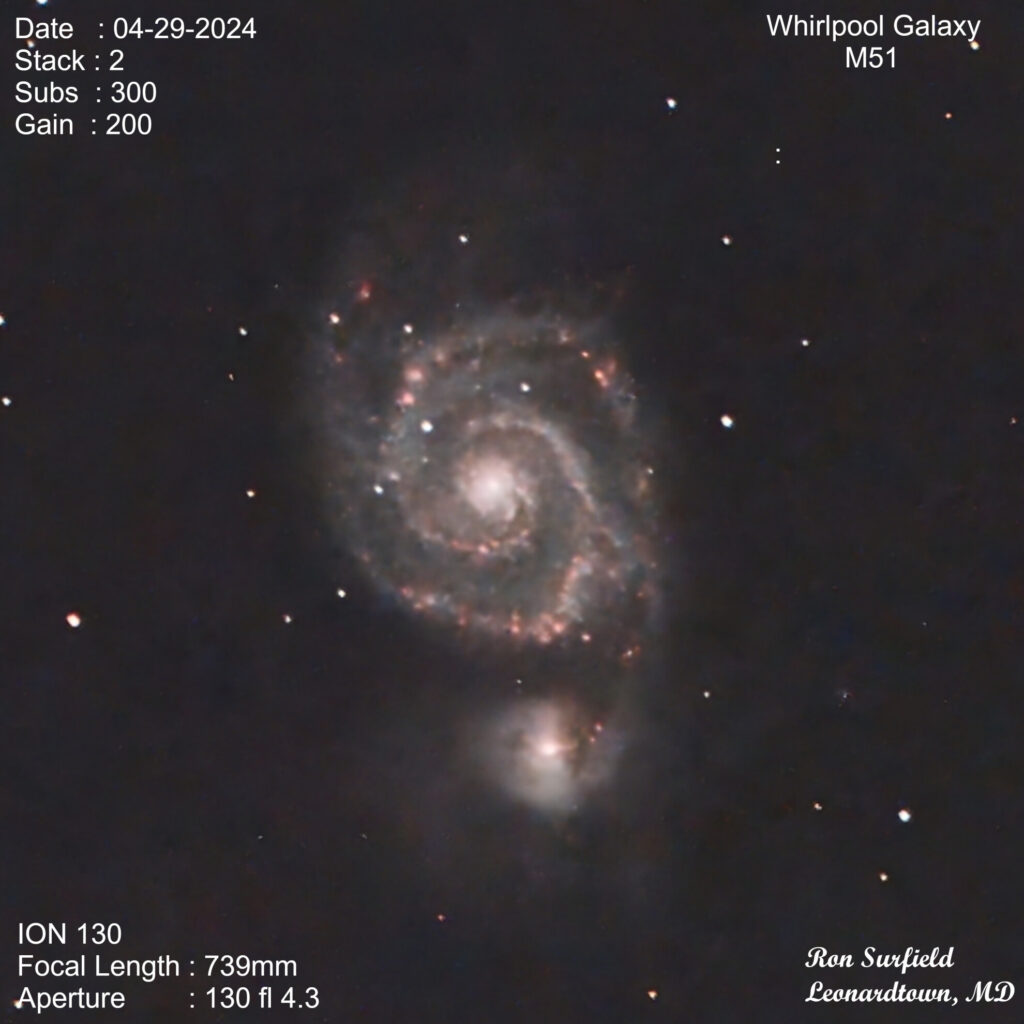
The Whirlpool Galaxy lies at a distance of 23 to 31 million light-years from Earth. Based on the 1991 measurement by the Third Reference Catalogue of Bright Galaxies using the D25 isophote at the B-band, the Whirlpool Galaxy has a diameter of 23.58 kiloparsecs (76,900 light-years). Overall, the galaxy is about 88% the size of the Milky Way.[19][20][21] Its mass is estimated to be 160 billion solar masses, or around 10.3% of the mass of Milky Way Galaxy.[citation needed] It’s believed to be an estimated 400 million years old.
A black hole, once thought to be surrounded by a ring of dust, but now believed to be partially occluded by dust instead, exists at the heart of the spiral. A pair of ionization cones extend from the active galactic nucleus.
Spiral structure
The Whirlpool Galaxy has two, very prominent spiral arms that wind clockwise. One arm deviates from a constant angle significantly. The pronounced spiral structure of the Whirlpool Galaxy is believed to be the result of the close interaction between it and its companion galaxy NGC 5195, which may have passed through the main disk of M51 about 500 to 600 million years ago. In this proposed scenario, NGC 5195 came from behind M51 through the disk towards the observer and made another disk crossing as recently as 50 to 100 million years ago until it is where we observe it to be now, slightly behind M51.
Comments