Category: Astrophotos

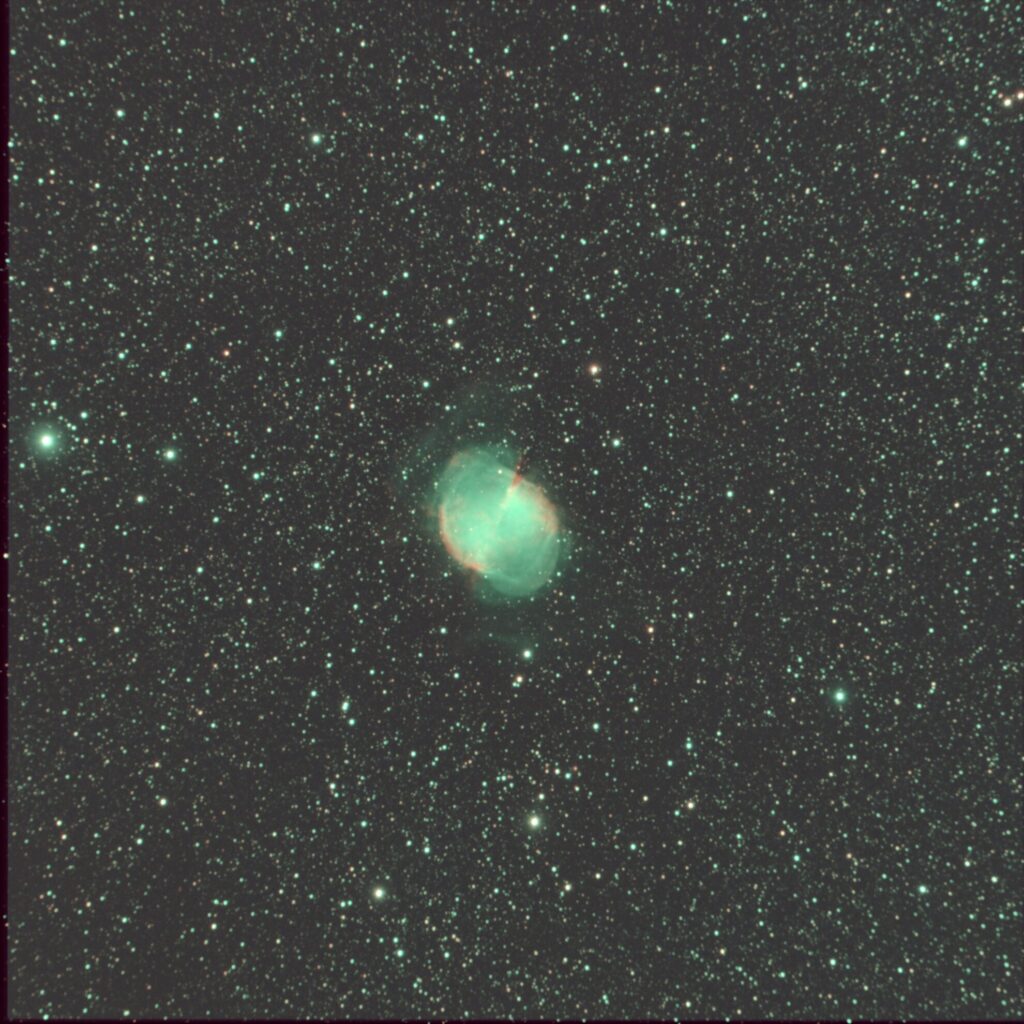
  • M27-1

    The Dumbbell Nebula (also known as the Apple Core NebulaMessier 27, and NGC 6853) is a planetary nebula (nebulosity surrounding a white dwarf) in the constellation Vulpecula, at a distance of about 1360 light-years. It was the first such nebula to be discovered, by Charles Messier in 1764. At its brightness of visual magnitude 7.5 and diameter of about 8 arcminutes, it is easily visible in binoculars and is a popular observing target in amateur telescopes.

    The Dumbbell Nebula appears shaped like a prolate spheroid and is viewed from our perspective along the plane of its equator. In 1992, Moreno-Corral et al. computed that its rate of expansion angularly was, viewed from our distance, no more than 2.3 arcseconds (″) per century. From this, an upper limit to the age of 14,600 years may be determined. In 1970, Bohuski, Smith, and Weedman found an expansion velocity of 31 km/s. Given its semi-minor axis radius of 1.01 ly, this implies that the kinematic age of the nebula is 9,800 years.

    Like many nearby planetary nebulae, the Dumbbell contains knots. Its central region is marked by a pattern of dark and bright cusped knots and their associated dark tails (see picture). The knots vary in appearance from symmetric objects with tails to rather irregular tail-less objects. Similarly to the Helix Nebula and the Eskimo Nebula, the heads of the knots have bright cusps which are local photoionization fronts.[5]

    The central star, a white dwarf progenitor, is estimated to have a radius which is 0.055±0.02 R (0.13 light seconds) which gives it a size larger than most other known white dwarfs. Its mass was estimated in 1999 by Napiwotzki to be 0.56±0.01 M.

  • M20

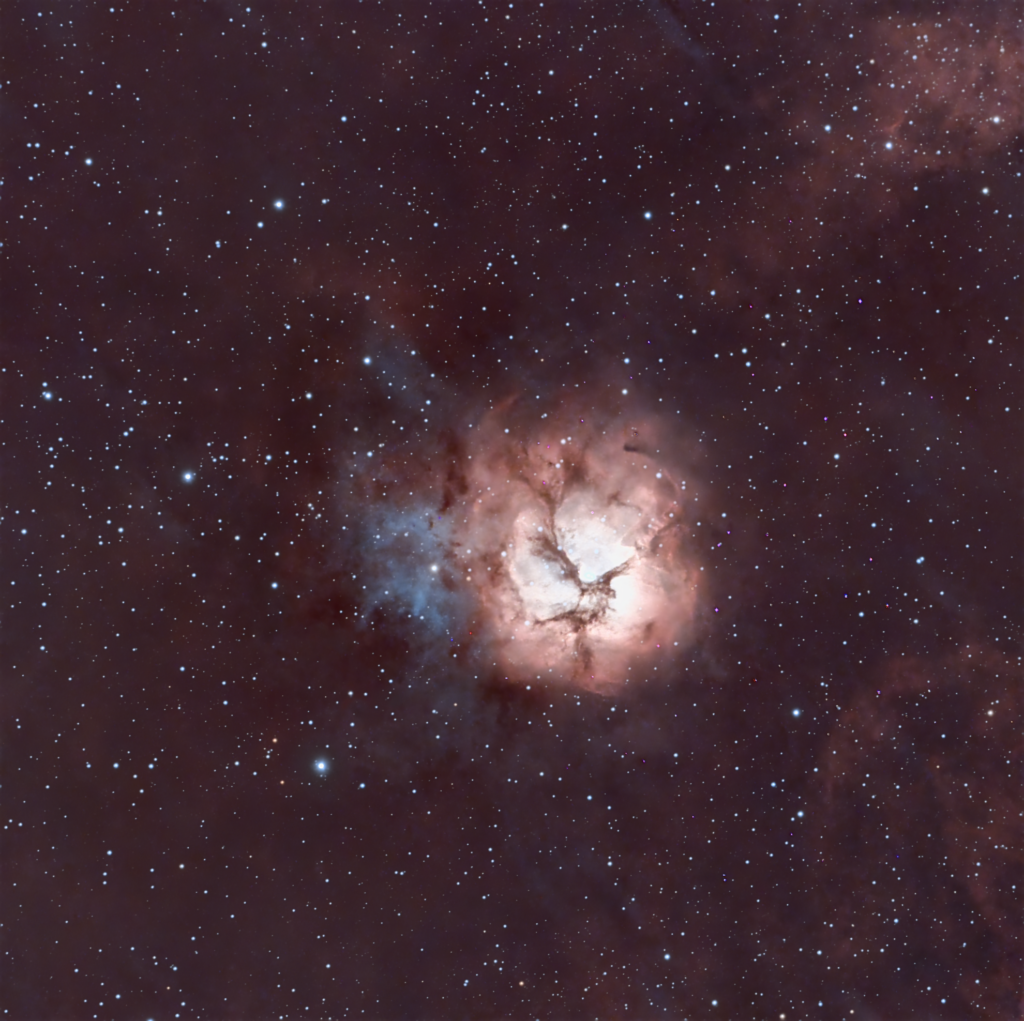
    The Trifid Nebula (catalogued as Messier 20 or M20 and as NGC 6514) is an H II region in the north-west of Sagittarius in a star-forming region in the Milky Way’s Scutum–Centaurus Arm. It was discovered by Charles Messier on June 5, 1764. Its name means ‘three-lobe’. The object is an unusual combination of an open cluster of stars, an emission nebula (the relatively dense, reddish-pink portion), a reflection nebula (the mainly NNE blue portion), and a dark nebula (the apparent ‘gaps’ in the former that cause the trifurcated appearance, also designated Barnard 85). Viewed through a small telescope, the Trifid Nebula is a bright and peculiar object, and is thus a perennial favorite of amateur astronomers.

    The most massive star that has formed in this region is HD 164492A, an O7.5III star with a mass more than 20 times the mass of the Sun. This star is surrounded by a cluster of approximately 3100 young stars.

  • M17

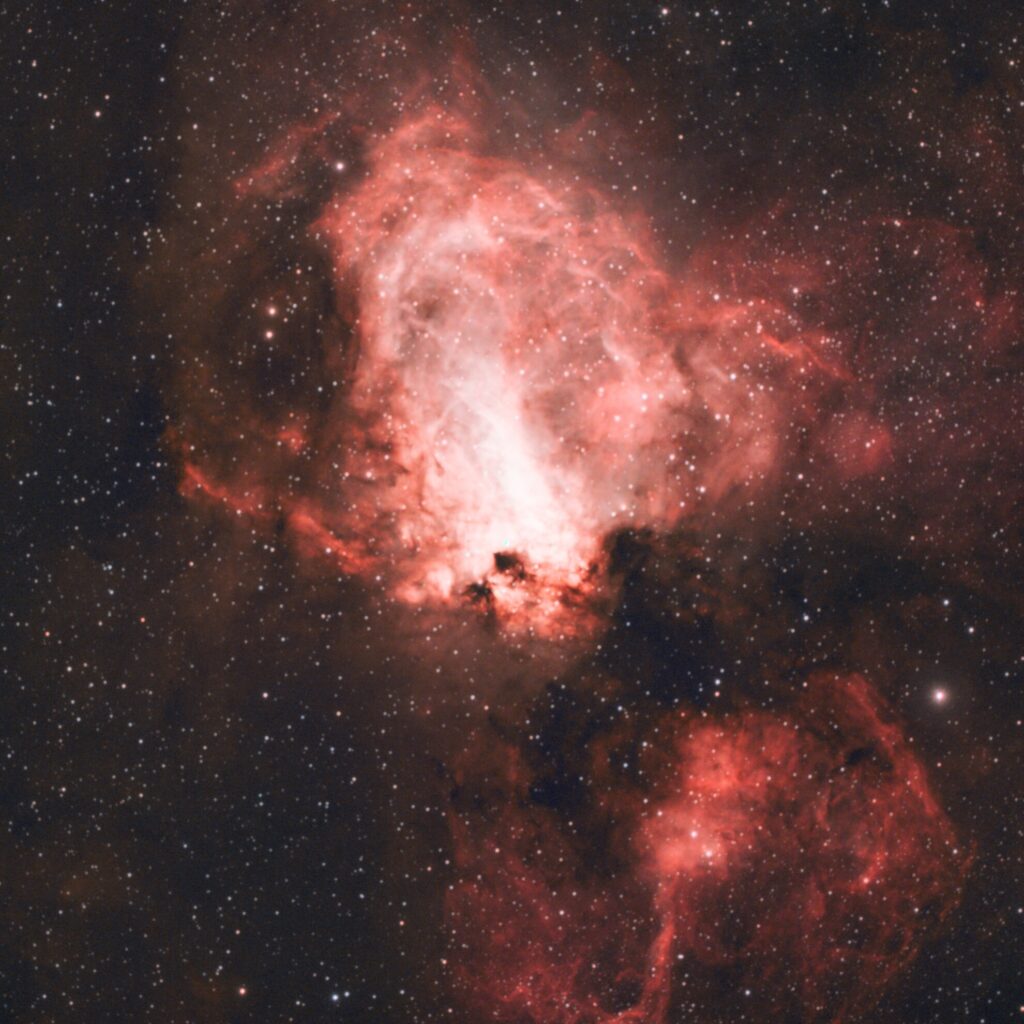
    The Omega Nebula is an H II region in the constellation Sagittarius. It was discovered by Philippe Loys de Chéseaux in 1745. Charles Messier catalogued it in 1764. It is by some of the richest starfields of the Milky Way, figuring in the northern two-thirds of Sagittarius. This feature is also known as the Swan NebulaCheckmark NebulaLobster Nebula, and the Horseshoe Nebula, and catalogued as Messier 17 or M17 or NGC 6618.

  • M16

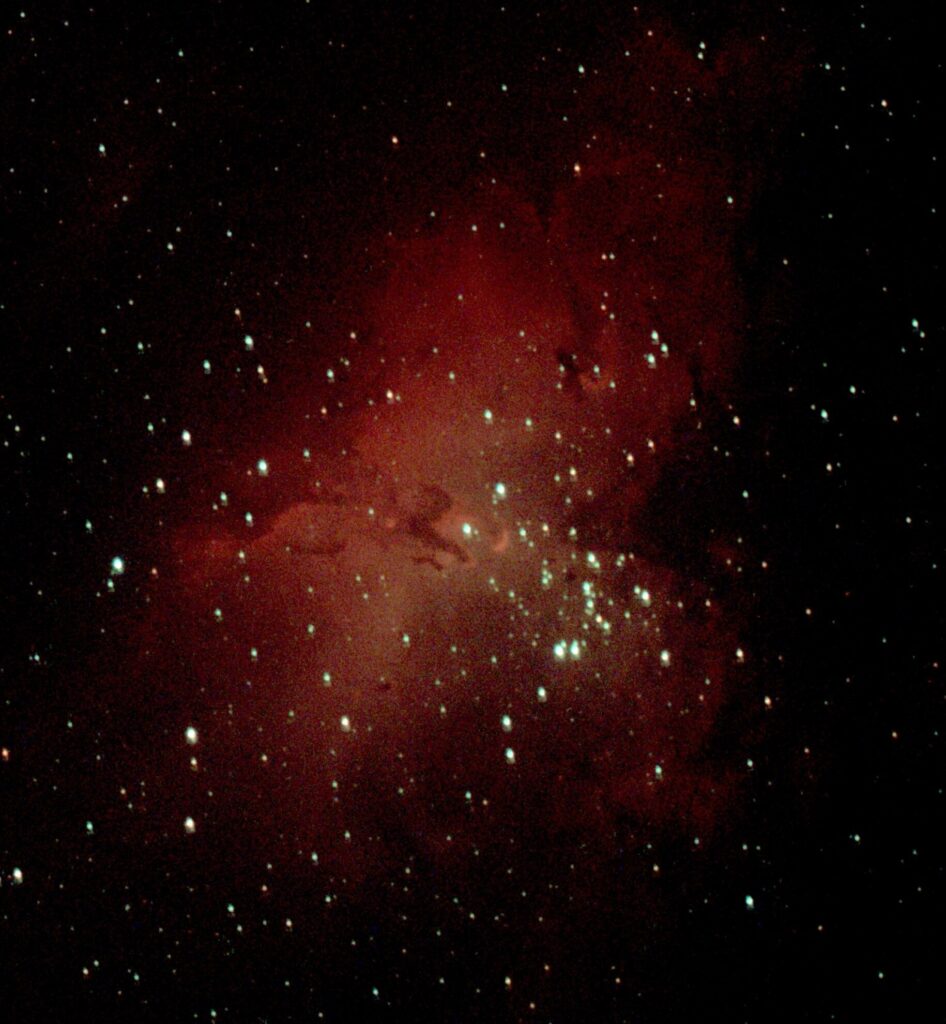
    The Eagle Nebula (catalogued as Messier 16 or M16, and as NGC 6611, and also known as the Star Queen Nebula) is a young open cluster of stars in the constellation Serpens, discovered by Jean-Philippe de Cheseaux in 1745–46. Both the “Eagle” and the “Star Queen” refer to visual impressions of the dark silhouette near the center of the nebula, an area made famous as the “Pillars of Creation” imaged by the Hubble Space Telescope. The nebula contains several active star-forming gas and dust regions, including the aforementioned Pillars of Creation. The Eagle Nebula lies in the Sagittarius Arm of the Milky Way..

  • M8

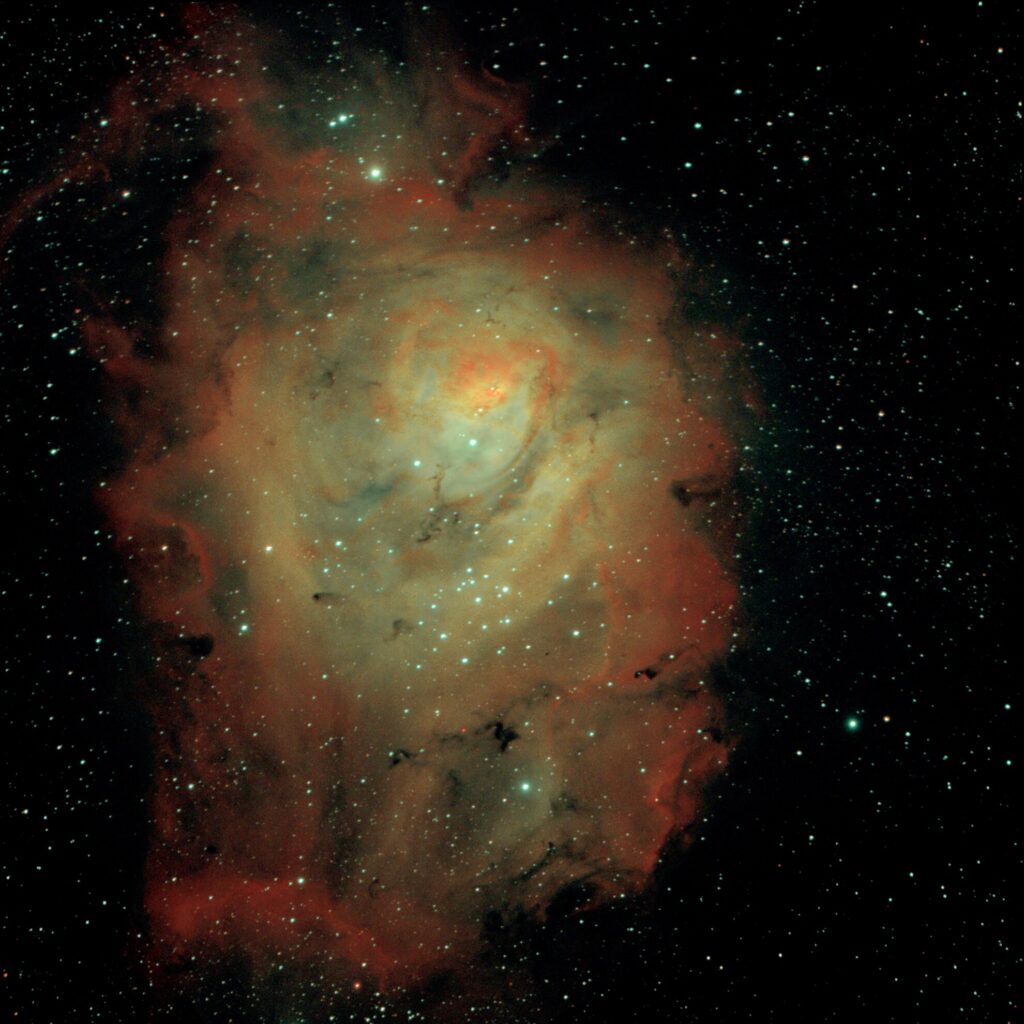
    The Lagoon Nebula (catalogued as Messier 8 or M8NGC 6523Sharpless 25RCW 146, and Gum 72) is a giant emission nebula with an H II region located in the constellation Sagittarius. Discovered by Giovanni Hodierna in 1654, it is one of only two star-forming nebulae faintly visible to the naked eye from mid-northern latitudes (the other being the Orion Nebula).

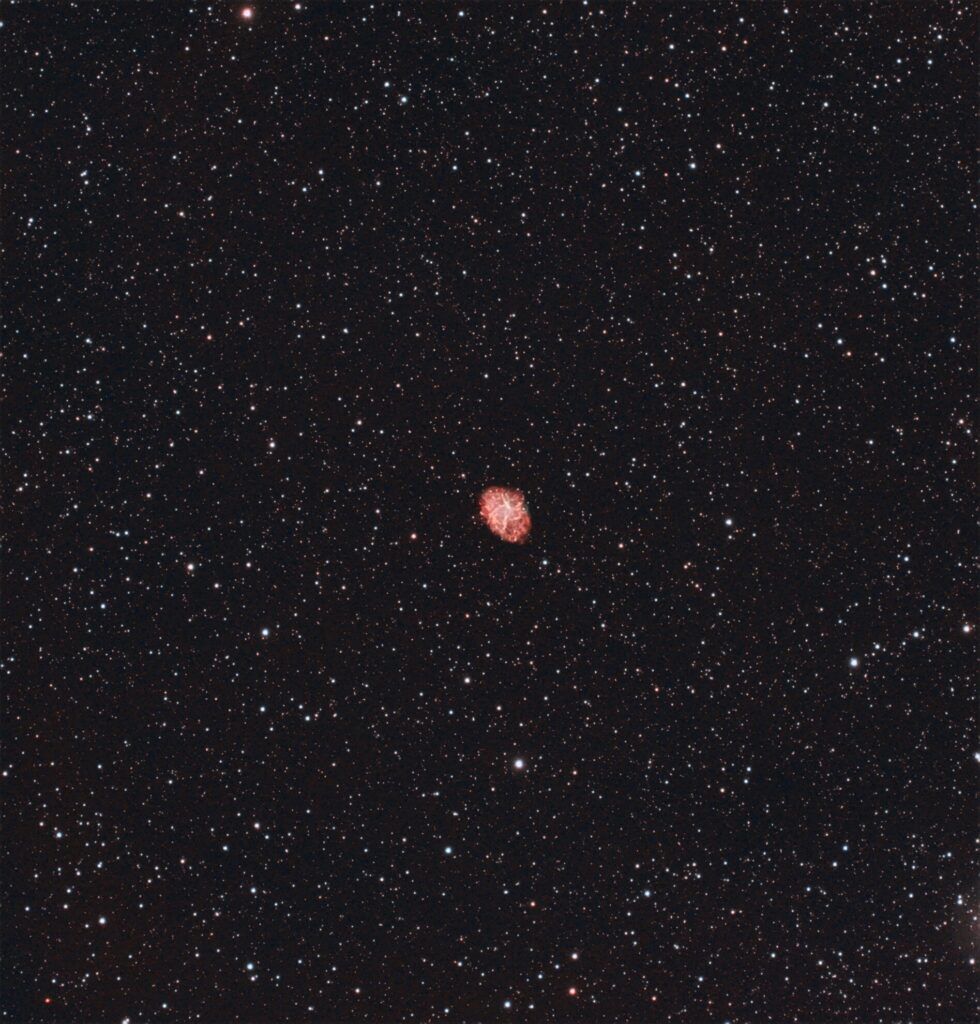
  • M1

    The Crab Nebula (catalogue designations M1NGC 1952Taurus A) is a supernova remnant and pulsar wind nebula in the constellation of Taurus. The common name comes from a drawing that somewhat resembled a crab with arms produced by William Parsons, 3rd Earl of Rosse, in 1842 or 1843 using a 36-inch (91 cm) telescope. The nebula was discovered by English astronomer John Bevis in 1731. It corresponds with a bright supernova observed in AD 1054 by MayanJapanese, and Arab stargazers his supernova was also recorded by Chinese astronomers as a guest star. The nebula was the first astronomical object identified that corresponds with a historically-observed supernova explosion.

    At an apparent magnitude of 8.4, comparable to that of Saturn’s moon Titan, it is not visible to the naked eye but can be made out using binoculars under favourable conditions. The nebula lies in the Perseus Arm of the Milky Way galaxy, at a distance of about 2.0 kiloparsecs (6,500 ly) from Earth. It has a diameter of 3.4 parsecs (11 ly), corresponding to an apparent diameter of some 7 arcminutes, and is expanding at a rate of about 1,500 kilometres per second (930 mi/s), or 0.5% of the speed of light.

    The Crab Pulsar, a neutron star 28–30 kilometres (17–19 mi) across with a spin rate of 30.2 times per second, lies at the center of the Crab Nebula. The star emits pulses of radiation from gamma rays to radio waves. At X-ray and gamma ray energies above 30 keV, the Crab Nebula is generally the brightest persistent gamma-ray source in the sky, with measured flux extending to above 10 TeV. The nebula’s radiation allows detailed study of celestial bodies that occult it. In the 1950s and 1960s, the Sun’s corona was mapped from observations of the Crab Nebula’s radio waves passing through it, and in 2003, the thickness of the atmosphere of Saturn’s moon Titan was measured as it blocked out X-rays from the nebula.

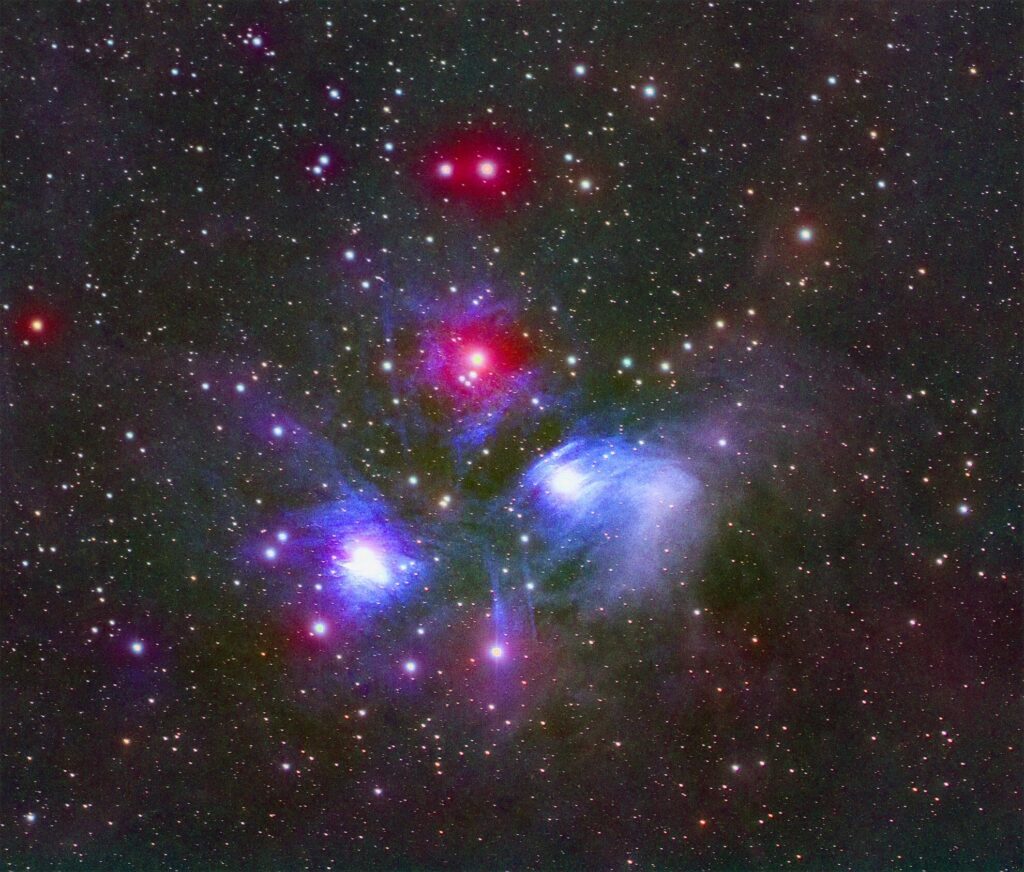
  • M45

    The Pleiades (/ˈpliː.ədiːz, ˈpleɪ-, ˈplaɪ-/ PLEE-ə-deez, PLAY-, PLY-), also known as Seven Sisters and Messier 45 (M45), is an asterism of an open star cluster containing young B-type stars in the northwest of the constellation Taurus. At a distance of about 444 light-years, it is among the nearest star clusters to Earth and the nearest Messier object to Earth, being the most obvious star cluster to the naked eye in the night sky. It contains over 1,000 stars, with the brightest six or seven being easily visible to the naked eye.

    The Pleiades cluster contains the reflection nebulae NGC 1432, an HII region, and NGC 1435, known as the Merope Nebula. Around 2330 BC the Pleiades marked the vernal point. Due to the brightness of its stars, the Pleiades is viewable from most areas on Earth, even in locations with significant light pollution.

    The cluster is dominated by hot blue luminous stars that have formed within the last 100 million years. Reflection nebulae around the brightest stars were once thought to be leftover material from their formation, but are now considered likely to be an unrelated dust cloud in the interstellar medium through which the stars are currently passing.[12] This dust cloud is estimated to be moving at a speed of approximately 18 km/s (11 mi/s) relative to the stars in the cluster.

    Computer simulations have shown that the Pleiades were probably formed from a compact configuration that once resembled the Orion Nebula. Astronomers estimate that the cluster will survive for approximately another 250 million years, after which the clustering will be lost due to gravitational interactions with the galactic neighborhood.

    Together with the open star cluster of the Hyades, the Pleiades form the Golden Gate of the Ecliptic. The Pleiades have been said to “resemble a tiny dipper,” and should not be confused with the “Little Dipper,” or Ursa Minor.

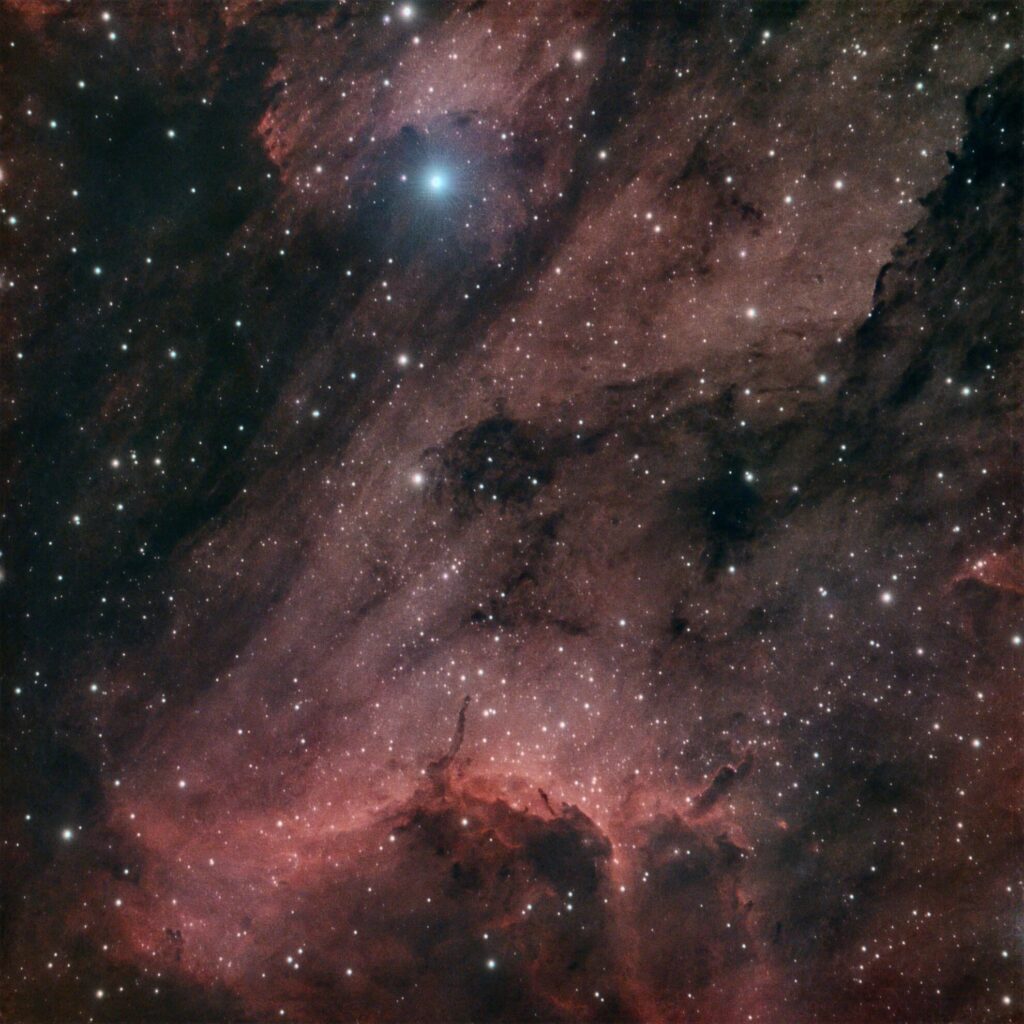
  • IC5070

    The Pelican Nebula (also known as IC 5070[1]) is an H II region associated with the North America Nebula in the constellation of Cygnus. The gaseous contortions of this emission nebula bear a resemblance to a pelican, giving rise to its name.[1] The Pelican Nebula is located nearby first magnitude star Deneb, and is divided from its more prominent neighbour, the North America Nebula, by a foreground molecular cloud filled with dark dust.[2] Both are part of the larger H II region of Westerhout 40.[2]

    The Pelican is much studied because it has a particularly active mix of star formation and evolving gas clouds. The light from young energetic stars is slowly transforming cold gas to hot and causing an ionization front gradually to advance outward. Particularly dense filaments of cold gas are seen to still remain, and among these are found two jets emitted from the Herbig–Haro object 555.[1] Millions of years from now this nebula might no longer be known as the Pelican, as the balance and placement of stars and gas will leave something that appears completely different.

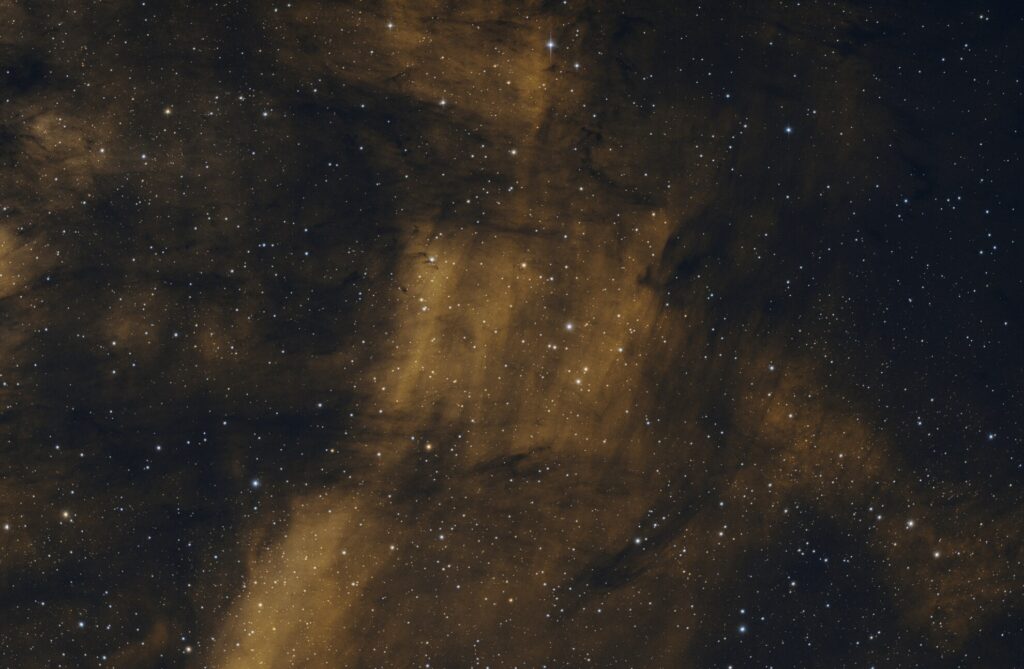
  • IC5068

    This is IC 5068, a low emission nebula (composed of clouds of hydrogen gas), neglected because it is located near the very photogenic North America and Pelican nebulae. The nebula is best known for the streaks of dark clouds that separate the hydrogen-colored regions, which also separate the nebula from its better-known neighbors. (All are located 1,600 light-years away in the constellation Cygnus.)

  • IC4172

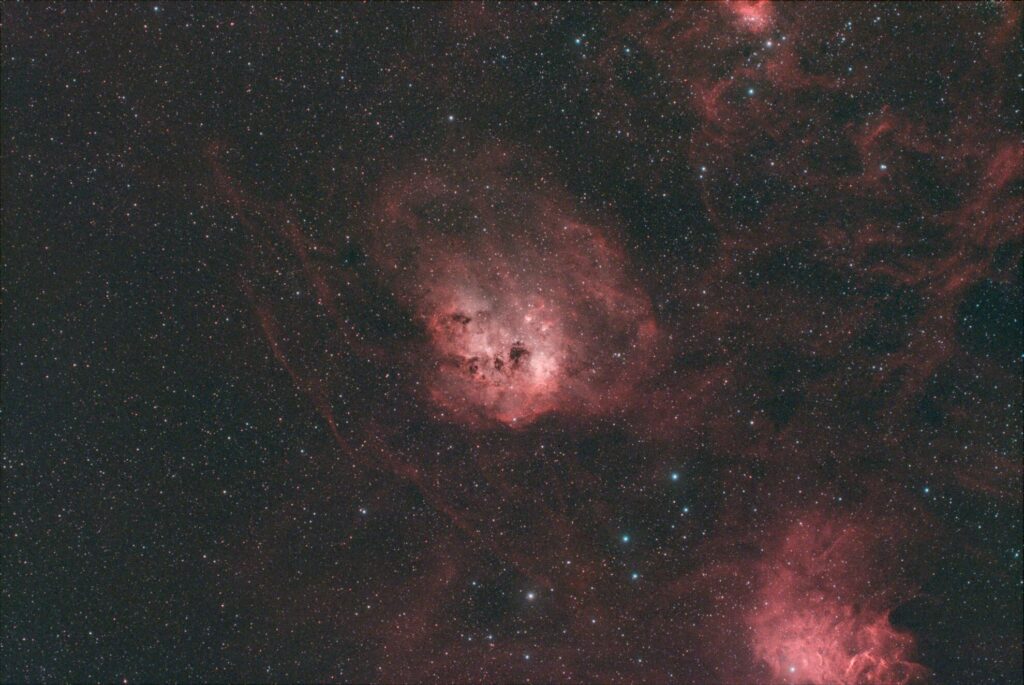
    IC 405 (also known as the Flaming Star NebulaSH 2-229, or Caldwell 31) is an emission and reflection nebula in the constellation Auriga north of the celestial equator, surrounding the bluish, irregular variable star AE Aurigae. It shines at magnitude +6.0. Its celestial coordinates are RA 05h 16.2m dec +34° 28′. It is located near the emission nebula IC 410, the open clusters M38 and M36, and the K-class star Iota Aurigae.

    The nebula measures approximately 37.0′ x 19.0′, and lies about 1,500 light-years away from Earth. It is believed that the proper motion of the central star can be traced back to the Orion’s Belt area. The nebula is about 5 light-years across.