Category: Astrophotos

  • IC4102

    IC 405 (also known as the Flaming Star NebulaSH 2-229, or Caldwell 31) is an emission and reflection nebula in the constellation Auriga north of the celestial equator, surrounding the bluish, irregular variable star AE Aurigae. It shines at magnitude +6.0. Its celestial coordinates are RA 05h 16.2m dec +34° 28′. It is located near the emission nebula IC 410, the open clusters M38 and M36, and the K-class star Iota Aurigae.

    The nebula measures approximately 37.0′ x 19.0′, and lies about 1,500 light-years away from Earth. It is believed that the proper motion of the central star can be traced back to the Orion’s Belt area. The nebula is about 5 light-years across.

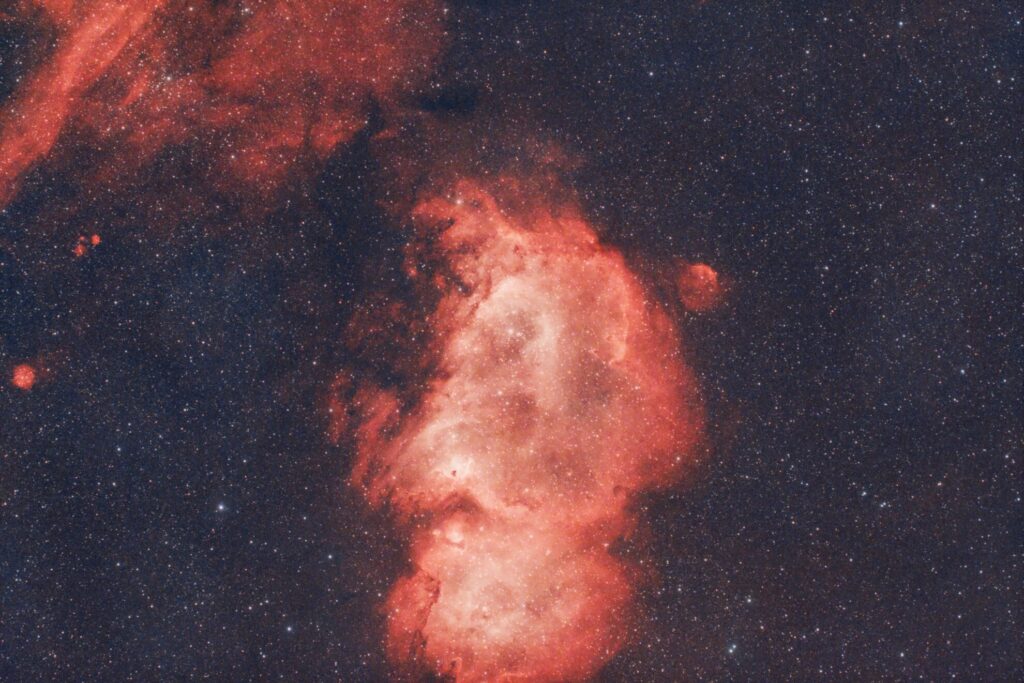
  • IC1805

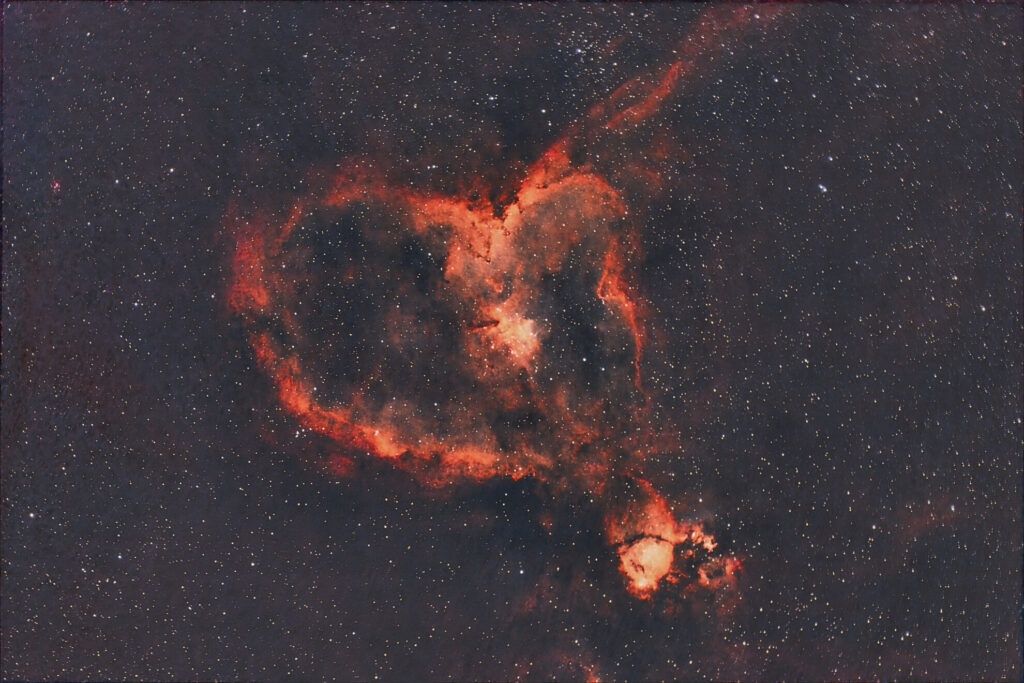
    The Heart Nebula (also known as the Running Dog NebulaSharpless 2-190) is an emission nebula, 7,500 light-years (2,300 pc) away from Earth and located in the Perseus Arm of the Galaxy in the constellation Cassiopeia. It was discovered by William Herschel on 3 November 1787.  In 1958, it was identified as a radio source by Gart Westerhout and is therefore also referred to as Westerhout 4 (or W4). It displays glowing ionized hydrogen gas and darker dust lanes.

    The brightest part of the nebula (a knot at its western edge) is separately classified as NGC 896, because it was the first part of the nebula to be discovered. The nebula’s intense red output and its morphology are driven by the radiation emanating from a small group of hot stars near the nebula’s center. This open cluster of stars, known as Collinder 26, Melotte 15, or IC 1805, contains a few bright stars nearly 50 times the mass of the Sun, and many more dim stars that are only a fraction of the Solar mass.

    The Heart Nebula is also made up of ionized oxygen and sulfur gasses, which are responsible for the rich blue and orange colors seen in narrowband images. The nebula also spans almost 2 degrees in the sky, covering an area four times that of the diameter of the full moon.

    The Heart Nebula belongs to a larger structure known as the W3/W4/W5 complex. It is also the brightest part of a superbubble known as the W4 superbubble, sometimes referred to as the W4 chimney, as it is believed that hot gas is transferred from the galactic disk to the halo through this structure.
  • IC1396

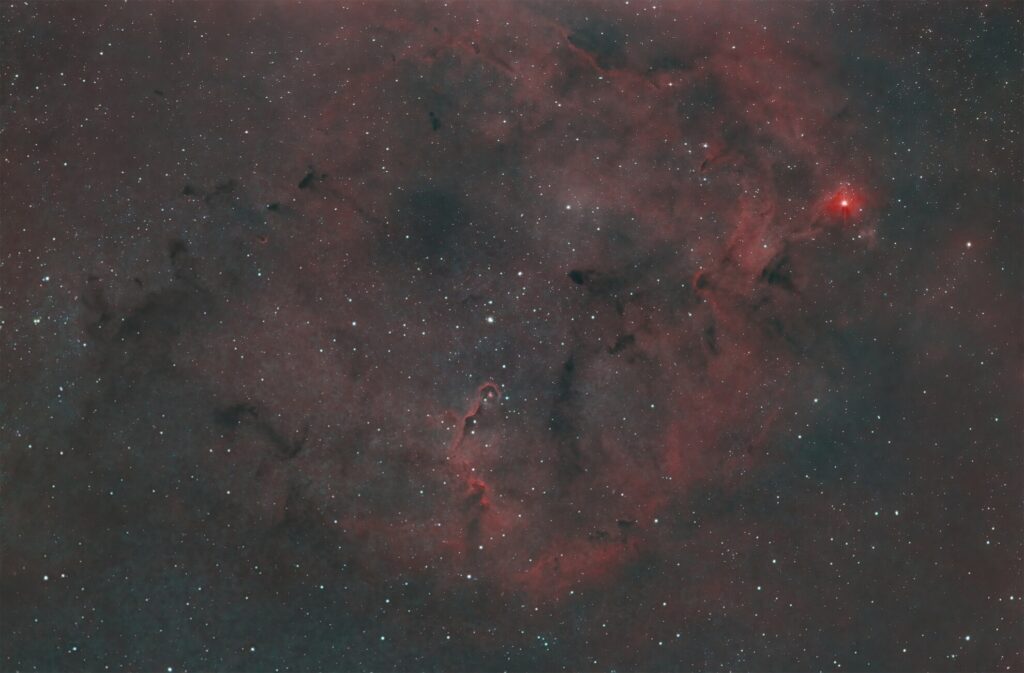
    The Elephant’s Trunk Nebula (IC 1396A) is a concentration of interstellar gas and dust within the much larger ionized gas region IC 1396 located in the constellation Cepheus about 2,400 light years away from Earth.[1] The nebula is a dark, dense globule that gets its name from its appearance at visible light wavelengths, where there is a dark patch with a bright, sinuous rim. The bright rim is the surface of the dense cloud that is being illuminated and ionized by a very bright, massive multiple star (HD 206267) that is just to the east of the Elephant’s Trunk Nebula . The entire IC 1396 region is ionized by the massive star, except for dense globules that can protect themselves from the star’s harsh ultraviolet rays.[citation needed]

    The Elephant’s Trunk Nebula is now thought to be a site of star formation, containing several very young (less than 100,000 yr) stars that were discovered in infrared images in 2003. Two older (but still young, a couple of million years, by the standards of stars, which live for billions of years) stars are present in a small, circular cavity in the head of the globule. Winds from these young stars may have emptied the cavity.[citation needed]

    The combined action of the light from the massive star ionizing and compressing the rim of the cloud, and the wind from the young stars shifting gas from the center outward lead to very high compression in the Elephant’s Trunk Nebula. This pressure has triggered the current generation of protostars.[2][3]

  • IC1340

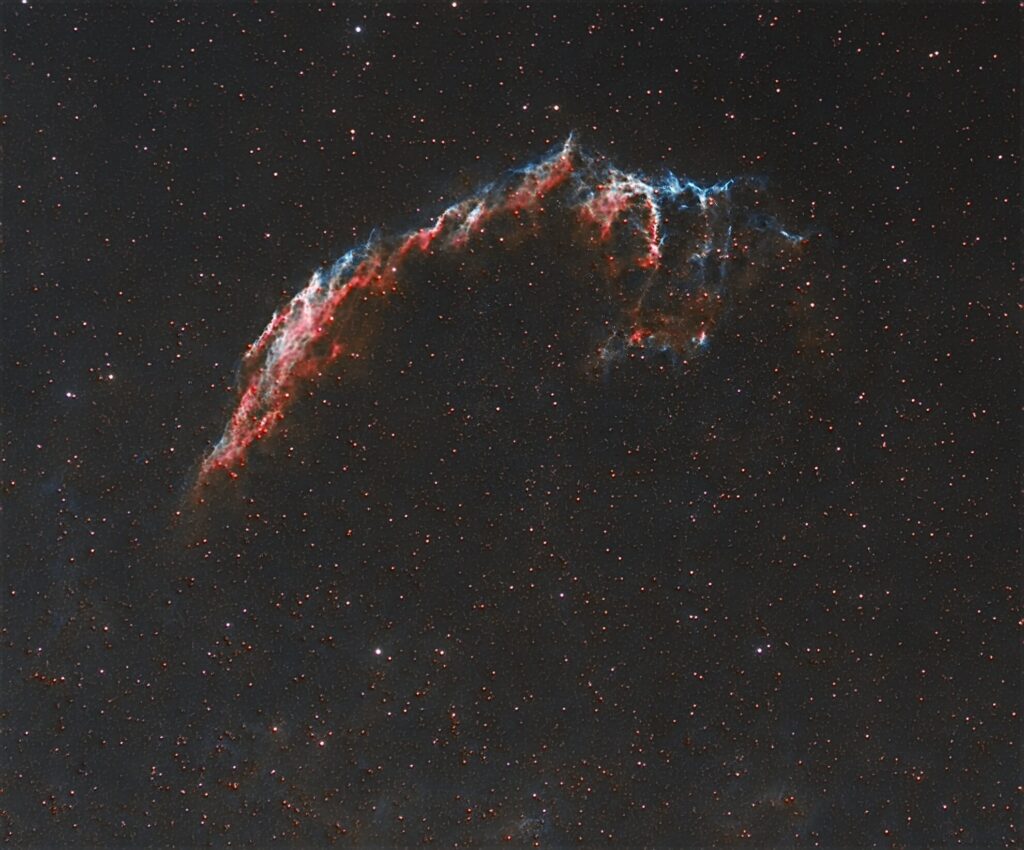
    The Veil Nebula is a cloud of heated and ionized gas and dust in the constellation Cygnus.[4]

    It constitutes the brightest parts of the visible portion of the Cygnus Loop,[5] a supernova remnant, many portions of which have acquired their own individual names and catalogue identifiers. The source supernova was a star 20 times more massive than the Sun which exploded between 10,000 and 20,000 years ago.[2] At the time of the explosion, the supernova would have appeared brighter than Venus in the sky, and visible in the daytime.[6] The remnants have since expanded to cover an area of the sky roughly 3 degrees in diameter (about 6 times the diameter, and 36 times the area, of the full Moon).[4] While previous distance estimates have ranged from 1,200 to 5,800 light-years, a 2018 determination of 2,400 light-years is based on direct astrometric measurements.[2] (The distance estimates affect also the estimates of size and age.)

    The Hubble Space Telescope captured several images of the nebula. The analysis of the emissions from the nebula indicates the presence of oxygensulfur, and hydrogen.[7] The Cygnus Loop is also a strong emitter of radio waves and x-rays.[8]

  • IC1318

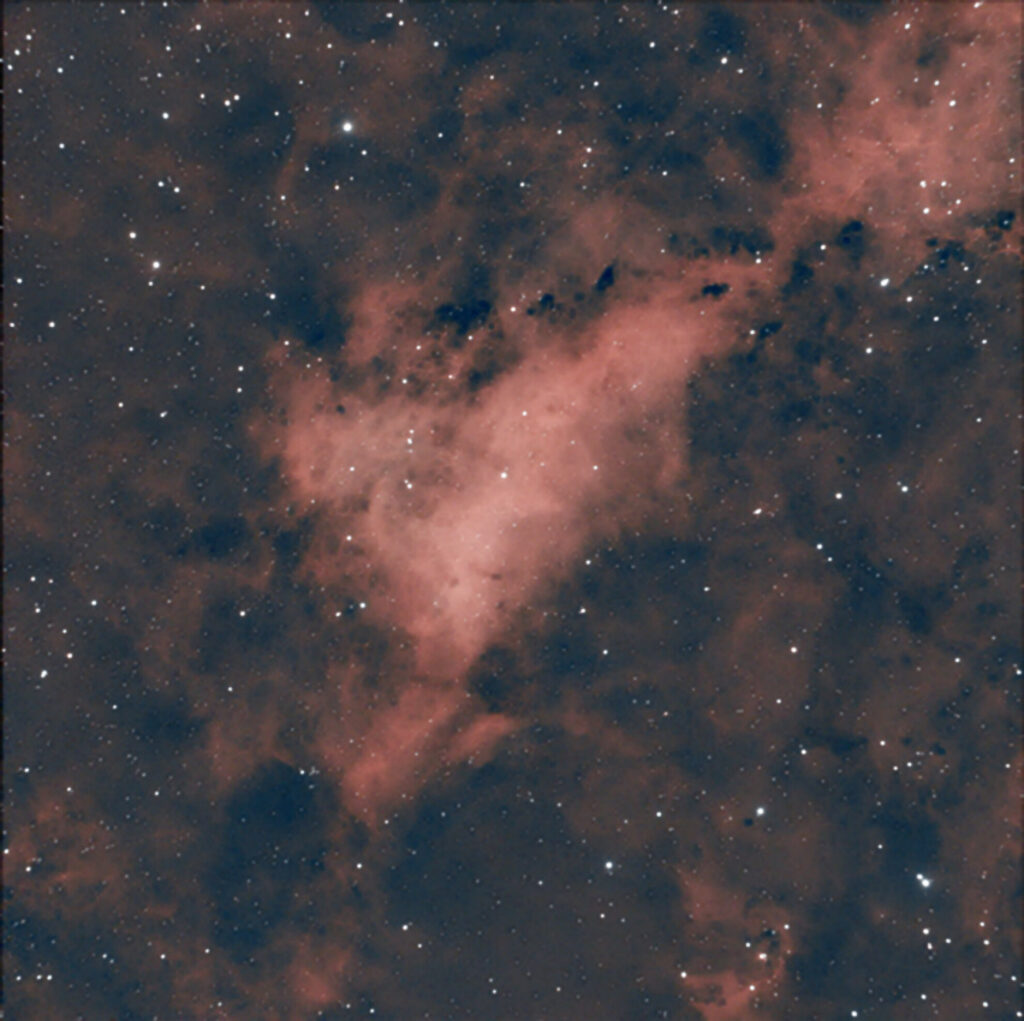
    IC 1318 (also known as Gamma Cygni Nebula) is the diffuse emission nebula and a H II region surrounding the star Sadr (γ Cygni) at the center of Cygnus’s cross thus getting a nickname Sadr Region. The Sadr Region is one of the surrounding nebulous regions; others include the Butterfly Nebula and the Crescent Nebula. It contains many dark nebulae in addition to the emission diffuse nebulae.

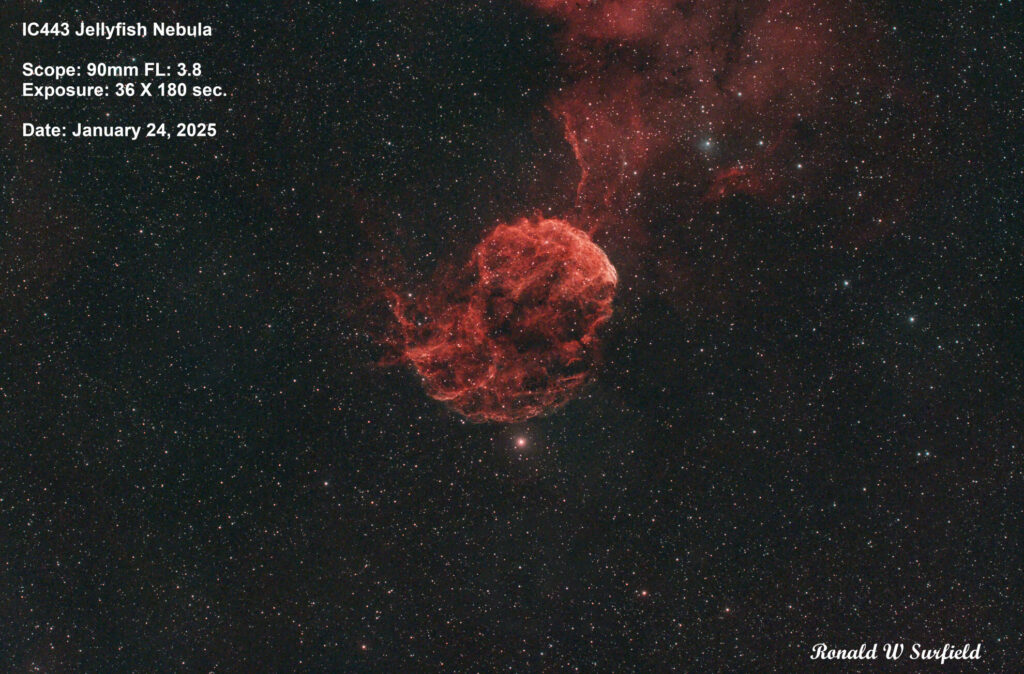
  • IC443

    IC 443 (also known as the Jellyfish Nebula and Sharpless 248 (Sh2-248)) is a galactic supernova remnant (SNR) in the constellation Gemini. On the plane of the sky, it is located near the star Eta Geminorum. Its distance is roughly 5,000 light years from Earth.

    IC 443 may be the remains of a supernova that occurred 30,000 – 35,000 years ago. The same supernova event likely created the neutron star CXOU J061705.3+222127, the collapsed remnant of the stellar core. IC 443 is one of the best-studied cases of supernova remnants interacting with surrounding molecular clouds.

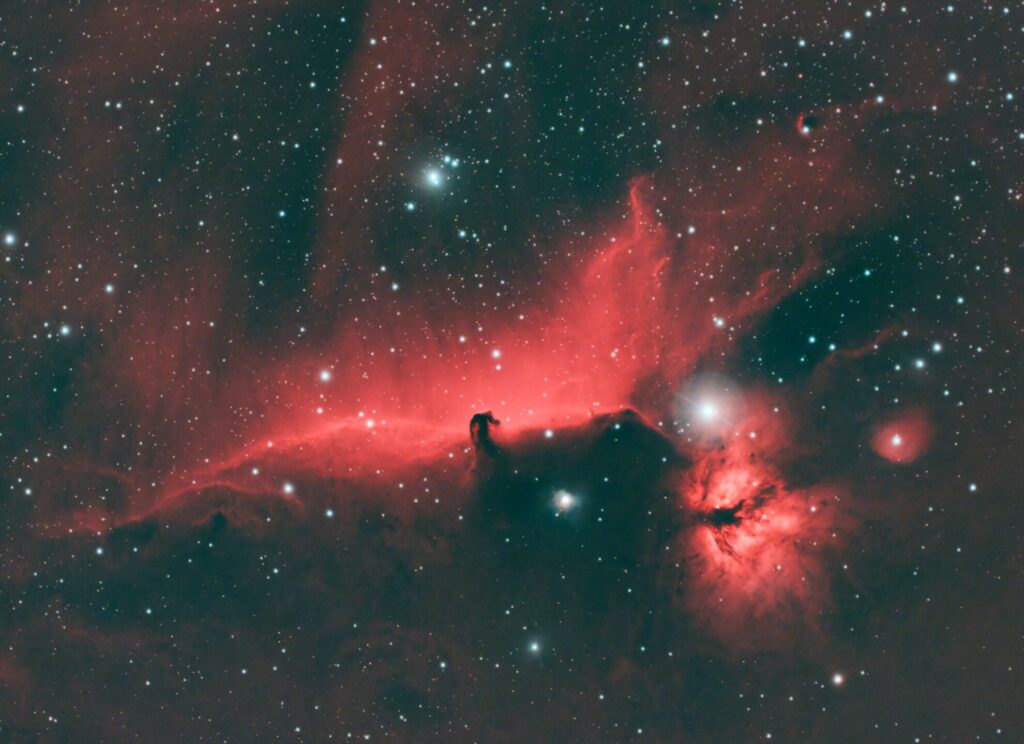
  • IC434

    The Horsehead Nebula (also known as Barnard 33 or B33) is a small dark nebula located about 1,375 light-years (422 pc)[1][2] from Earth in the constellation of Orion.[3] The nebula is located just to the south of Alnitak, the easternmost star of Orion’s Belt, and is part of the much larger Orion molecular cloud complex. It appears within the southern region of the dense dust cloud known as Lynds 1630, along the edge of the much larger, active star-forming H II region called IC 434.[2] It is one of the most identifiable nebulae because of its resemblance to a horse’s head.[4]

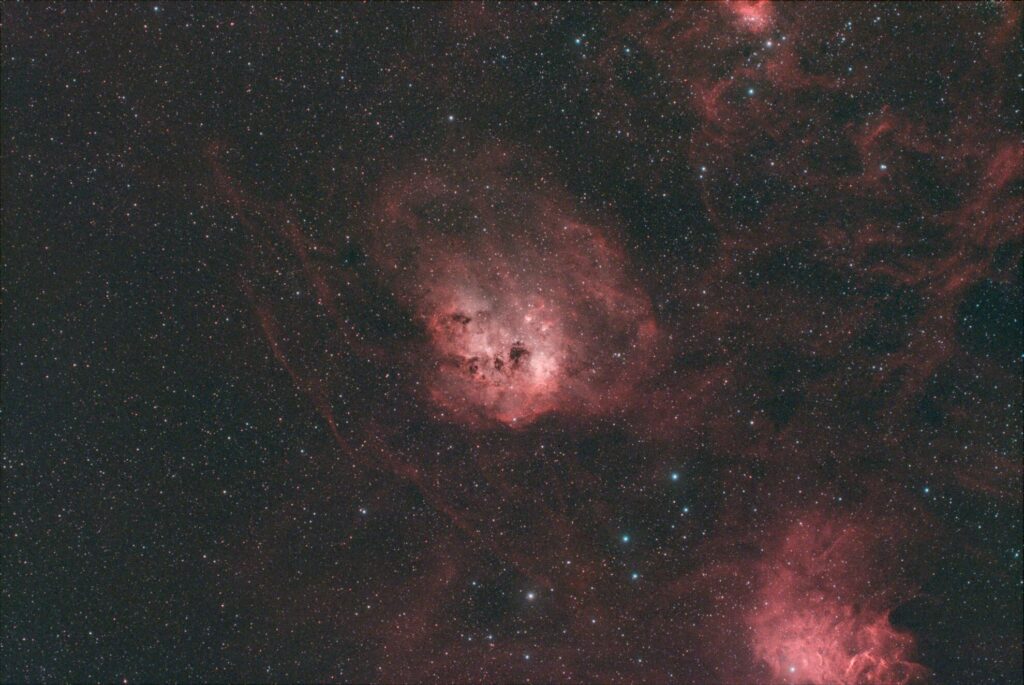
  • IC410

    IC 410 (also known as the Tadpole Nebula or Sh 2-365) is an emission nebula in the constellation of Auriga. It is part of a larger star-forming complex that includes the nearby IC 405 (Flaming Star Nebula)[3] and the open clusters M36 and M38.

    The nebula’s nickname, the Tadpole Nebula, derives from two prominent dense structures of gas and dust (each approximately 10 light-years long) that resemble tadpoles with long tails.[3][4]