Author: Ronald Surfield

  • NGC 2175

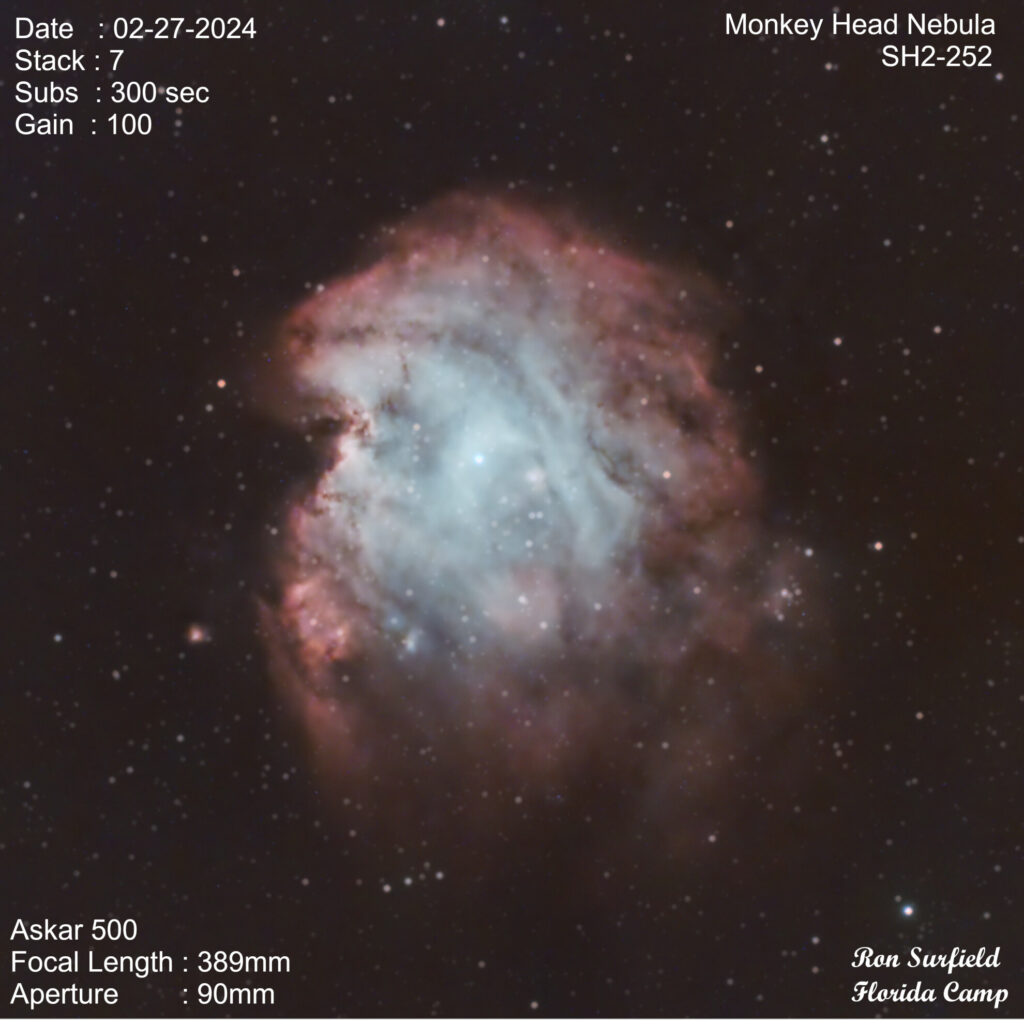
    NGC2175 Monkey Head Nebula

    NGC 2175 is a very young open cluster of stars in the equatorial constellation of Orion. It was discovered by Italian astronomer Giovanni Batista Hodierna before 1654 and independently discovered by German astronomer Karl Christian Bruhns on February 6, 1877. NGC 2175 is at a distance of about 5,290 light years away from Earth, and it is embedded in a diffuse nebulaNGC 2174.

    The estimated age of this cluster is nine million years. The nebula surrounding it is Sharpless catalog Sh 2-252, and it is sometimes called the Monkey Head Nebula due to its appearance. In 1970, a smaller star cluster designated NGC 2175s was discovered in the vicinity.

  • NGC 2024

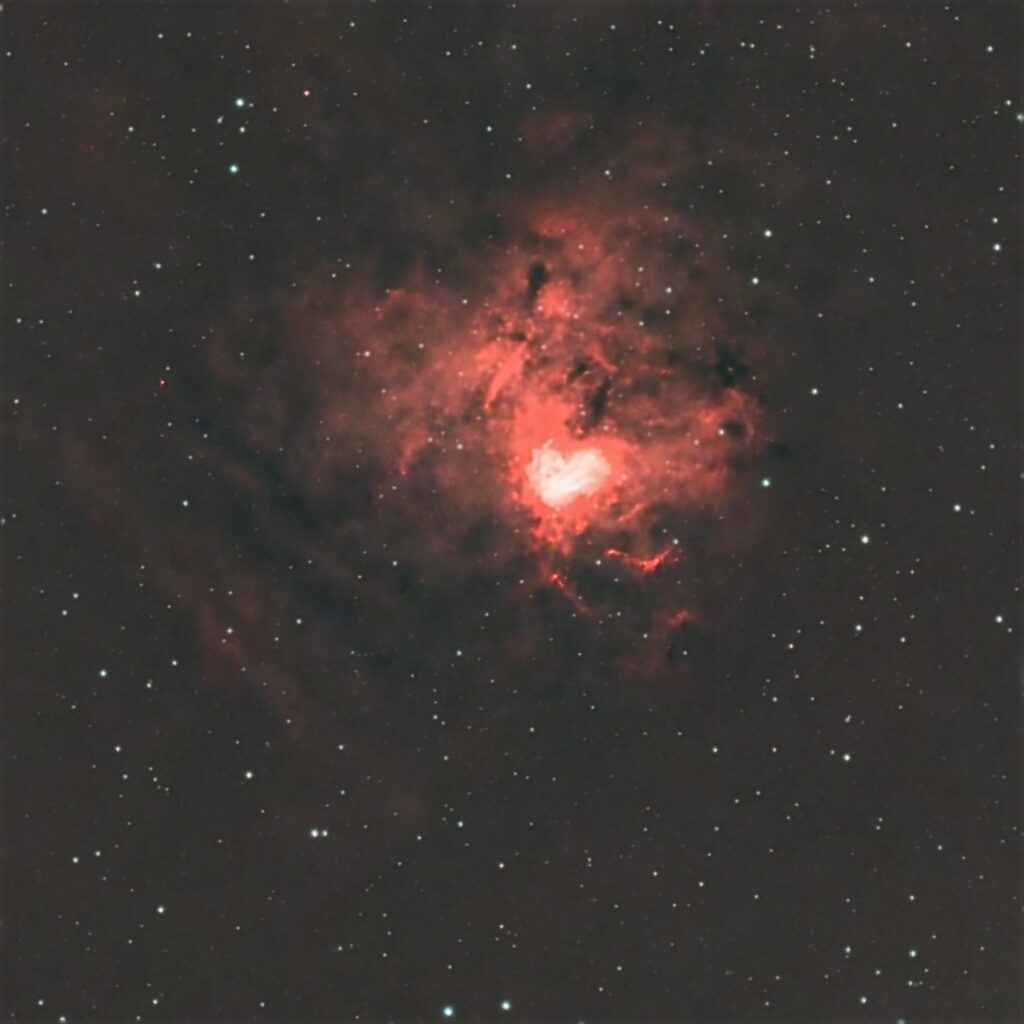
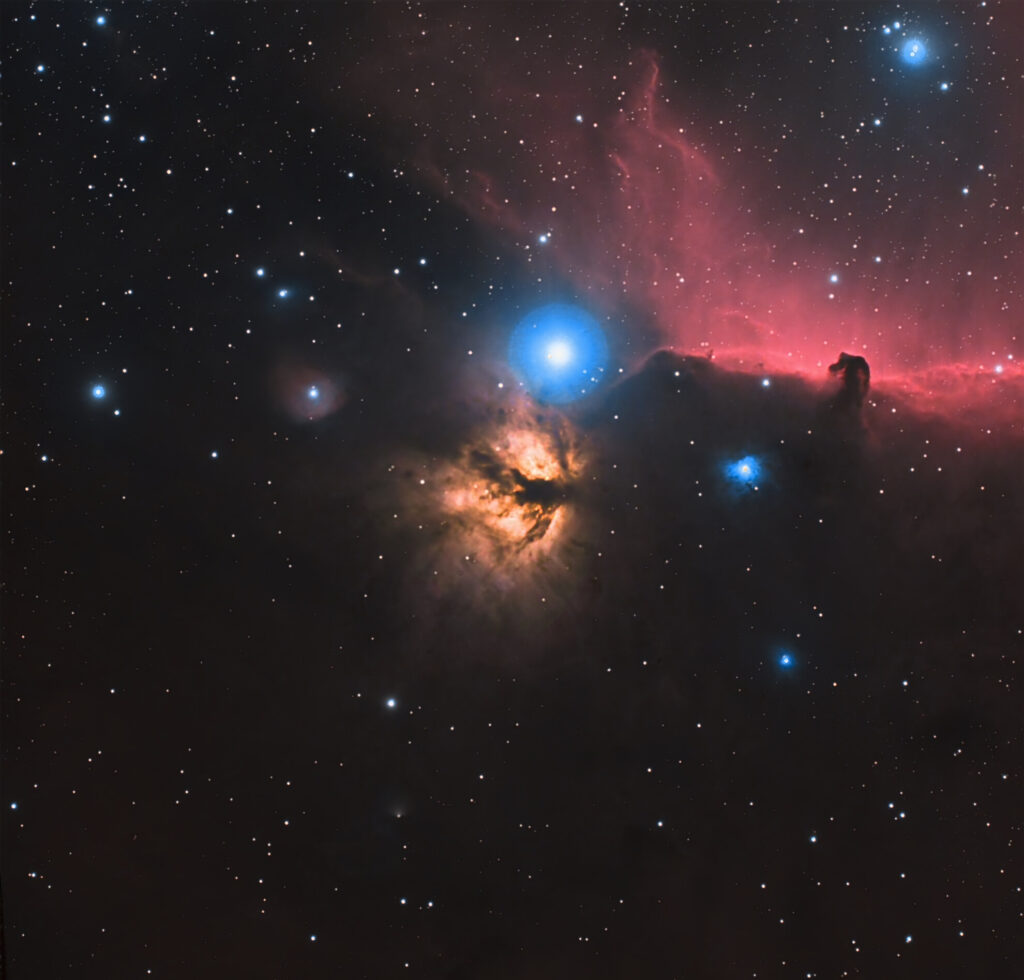
    NGC2024 Flame Nebula next to Horse Heade Nebula-02-04-2024

    The Flame Nebula, designated as NGC 2024 and Sh2-277, is an emission nebula in the constellation Orion. It is about 1350 light-years away. At that distance, the Flame Nebula lies within the Orion B cloud of the larger Orion Molecular Cloud Complex.

    The bright star Alnitak (ζ Ori), the easternmost star in the Belt of Orion, appears very close to the Flame Nebula in the sky. But the star and nebula are not physically associated with one another. The Flame Nebula contains a young cluster of stars which includes at least one hot, luminous O-type star labeled IRS 2b. The dense gas and dust in the foreground of the nebula heavily obscures the star cluster inside the nebula, making studies at infrared wavelengths most useful.

    The energetic ultraviolet light emitted by the central O-type star IRS 2b into the Flame Nebula causes the gas to be excited and heated. The glow of the nebula results from the energy input from this central star. Within the nebula and surrounding the central hot star is a cluster of young, lower-mass stars, 86% of which have circumstellar disksX-ray observations by the Chandra X-ray Observatory show several hundred young stars, out of an estimated population of 800 stars. X-ray and infrared images indicate that the young stars are concentrated near the center of the cluster.

  • NGC 1499

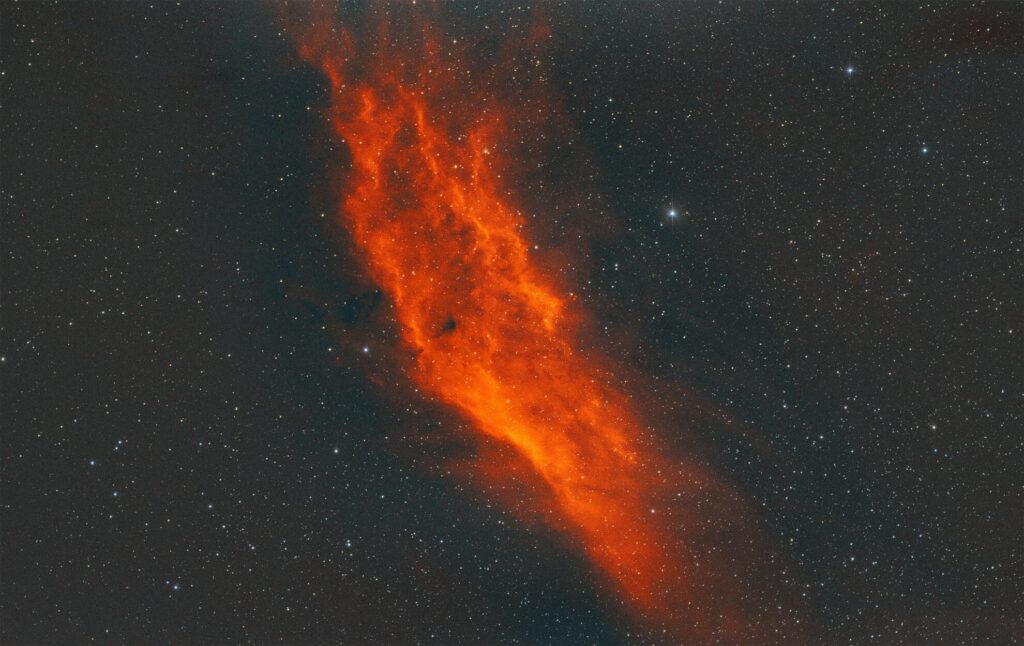
    NGC1499 California Nebula

    The California Nebula (Also known NGC 1499 or Sh2-220) is an emission nebula located in the constellation Perseus. Its name comes from its resemblance to the outline of the U.S. State of California in long exposure photographs.

    By coincidence, the California Nebula transits in the zenith in central California as the latitude matches the declination of the object.

  • NGC 1491

    NGC1491 Sharpened 24-02-25

    NGC 1491, also known as LBN 704SH2-206 or the Fossil Footprint Nebula, is an emission type bright nebula located about 9,800 light years away from Earth in the constellation of Perseus. It was discovered on 23 December 1790 by William Herschel.

    The nebula gets its deep red coloration due to many massive stars (such as BD+50 866) embedded within NGC 1491 producing large amounts of ultraviolet radiation and ionizing the hydrogen gas that makes up the nebula.

  • NGC 896

    M109 2024-06-14

    The Dumbbell Nebula (also known as the Apple Core NebulaMessier 27, and NGC 6853) is a planetary nebula (nebulosity surrounding a white dwarf) in the constellation Vulpecula, at a distance of about 1360 light-years. It was the first such nebula to be discovered, by Charles Messier in 1764. At its brightness of visual magnitude 7.5 and diameter of about 8 arcminutes, it is easily visible in binoculars and is a popular observing target in amateur telescopes.

    The Dumbbell Nebula appears shaped like a prolate spheroid and is viewed from our perspective along the plane of its equator. In 1992, Moreno-Corral et al. computed that its rate of expansion angularly was, viewed from our distance, no more than 2.3 arcseconds (″) per century. From this, an upper limit to the age of 14,600 years may be determined. In 1970, Bohuski, Smith, and Weedman found an expansion velocity of 31 km/s. Given its semi-minor axis radius of 1.01 ly, this implies that the kinematic age of the nebula is 9,800 years.

    Like many nearby planetary nebulae, the Dumbbell contains knots. Its central region is marked by a pattern of dark and bright cusped knots and their associated dark tails (see picture). The knots vary in appearance from symmetric objects with tails to rather irregular tail-less objects. Similarly to the Helix Nebula and the Eskimo Nebula, the heads of the knots have bright cusps which are local photoionization fronts.

    The central star, a white dwarf progenitor, is estimated to have a radius which is 0.055±0.02 R (0.13 light seconds) which gives it a size larger than most other known white dwarfs. Its mass was estimated in 1999 by Napiwotzki to be 0.56±0.01.
  • NGC 891

    M109 2024-06-14

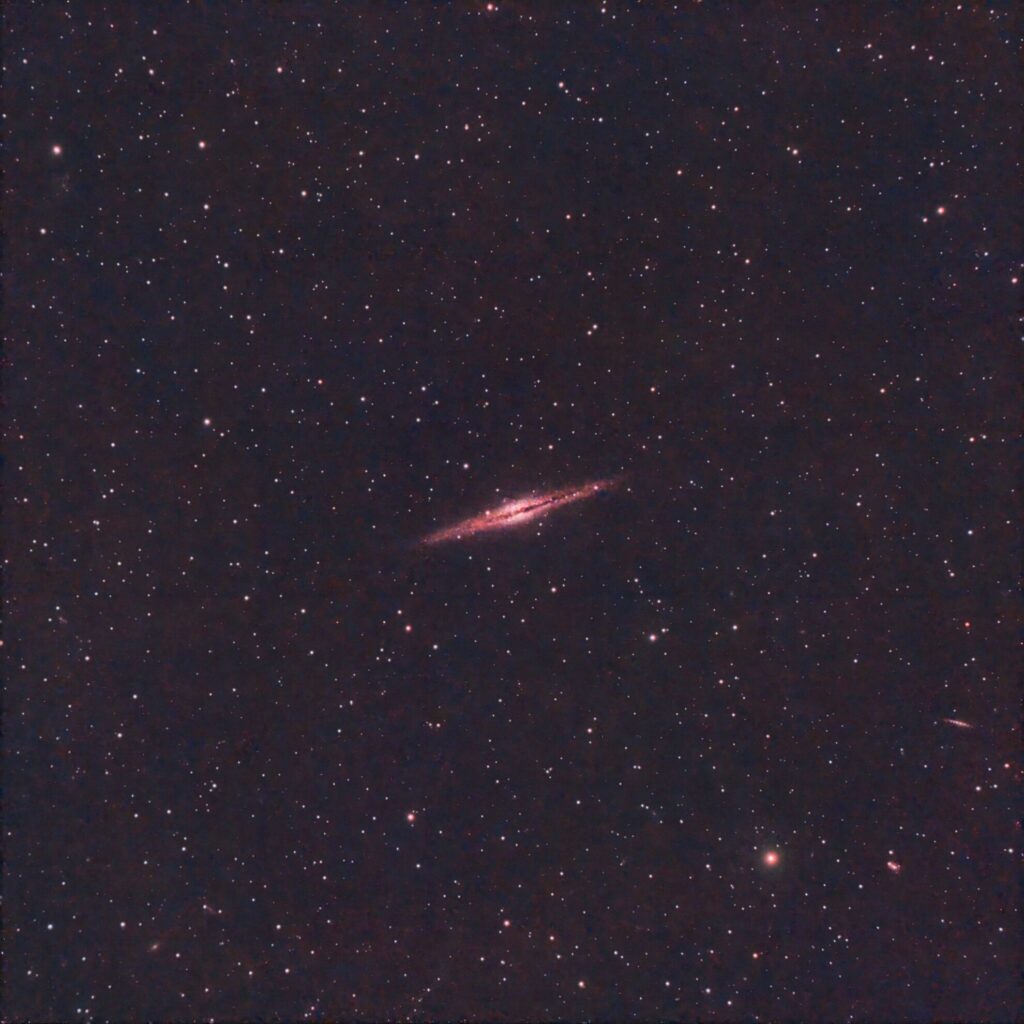
    NGC 891 (also known as Caldwell 23, the Silver Sliver Galaxy, and the Outer Limits Galaxy) is an edge-on unbarred spiral galaxy about 30 million light-years away in the constellation Andromeda. It was discovered by William Herschel on October 6, 1784. The galaxy is a member of the NGC 1023 group of galaxies in the Local Supercluster. It has an H II nucleus.

    The object is visible in small to moderate size telescopes as a faint elongated smear of light with a dust lane visible in larger apertures.

    In 1999, the Hubble Space Telescope imaged NGC 891 in infrared.

    In 2005, due to its attractiveness and scientific interest, NGC 891 was selected to be the first light image of the Large Binocular Telescope. In 2012, it was again used as a first light image of the Lowell Discovery Telescope with the Large Monolithic Imager.

    Supernova SN 1986J was discovered on August 21, 1986 at apparent magnitude 14.

  • NGC 281

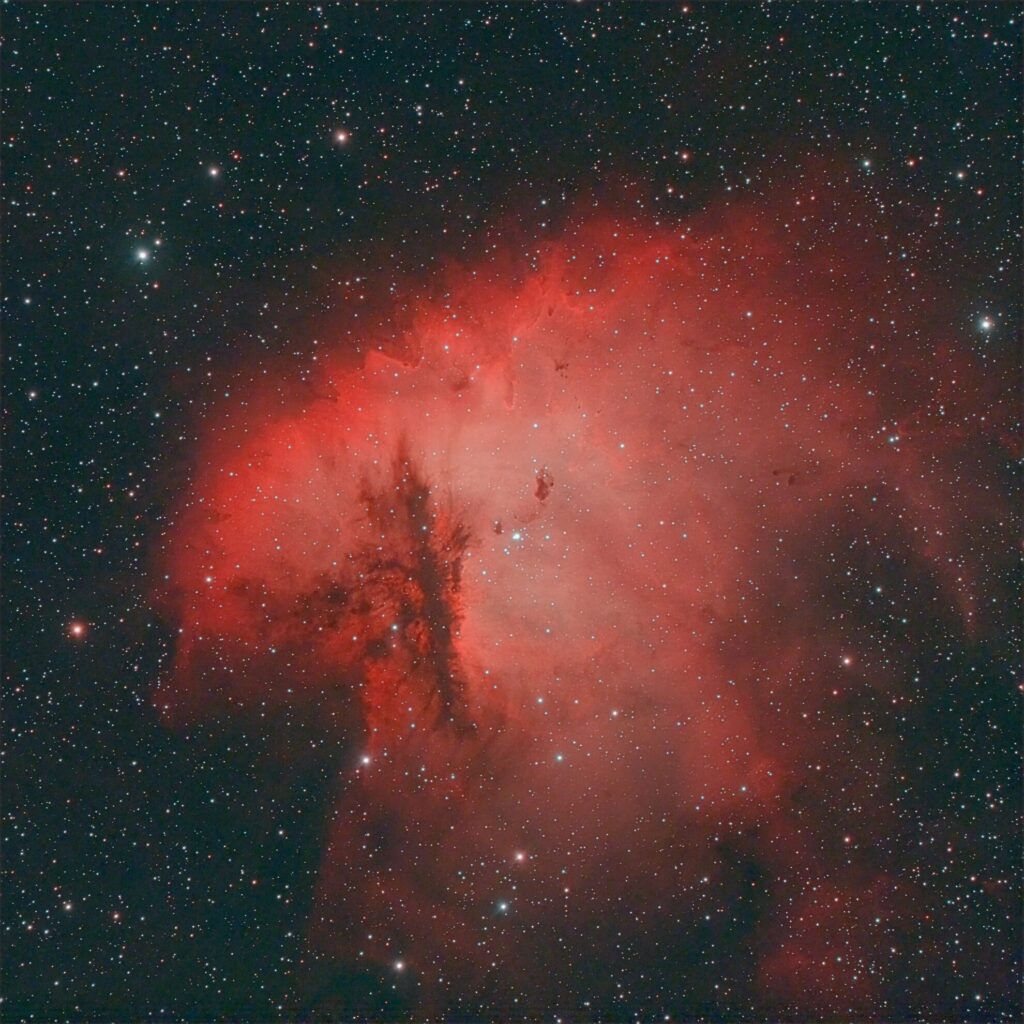
    NGC281 Pacman Nebula

    NGC 281IC 11 or Sh2-184 is a bright emission nebula and part of an H II region in the northern constellation of Cassiopeia and is part of the Milky Way‘s Perseus Spiral Arm. This 20×30 arcmin sized nebulosity is also associated with open cluster IC 1590, several Bok globules and the multiple star, B 1. It collectively forms Sh2-184, spanning over a larger area of 40 arcmin. A recent distance from radio parallaxes of water masers at 22 GHz made during 2014 is estimated it lies 2.82±0.20 kpc (9200 ly) from us. Colloquially, NGC 281 is also known as the Pacman Nebula for its resemblance to the video game character.

  • M109

    M109 2024-06-14

    The Dumbbell Nebula (also known as the Apple Core NebulaMessier 27, and NGC 6853) is a planetary nebula (nebulosity surrounding a white dwarf) in the constellation Vulpecula, at a distance of about 1360 light-years. It was the first such nebula to be discovered, by Charles Messier in 1764. At its brightness of visual magnitude 7.5 and diameter of about 8 arcminutes, it is easily visible in binoculars and is a popular observing target in amateur telescopes.

    The Dumbbell Nebula appears shaped like a prolate spheroid and is viewed from our perspective along the plane of its equator. In 1992, Moreno-Corral et al. computed that its rate of expansion angularly was, viewed from our distance, no more than 2.3 arcseconds (″) per century. From this, an upper limit to the age of 14,600 years may be determined. In 1970, Bohuski, Smith, and Weedman found an expansion velocity of 31 km/s. Given its semi-minor axis radius of 1.01 ly, this implies that the kinematic age of the nebula is 9,800 years.

    Like many nearby planetary nebulae, the Dumbbell contains knots. Its central region is marked by a pattern of dark and bright cusped knots and their associated dark tails (see picture). The knots vary in appearance from symmetric objects with tails to rather irregular tail-less objects. Similarly to the Helix Nebula and the Eskimo Nebula, the heads of the knots have bright cusps which are local photoionization fronts.

    The central star, a white dwarf progenitor, is estimated to have a radius which is 0.055±0.02 R (0.13 light seconds) which gives it a size larger than most other known white dwarfs. Its mass was estimated in 1999 by Napiwotzki to be 0.56±0.01.
  • M106

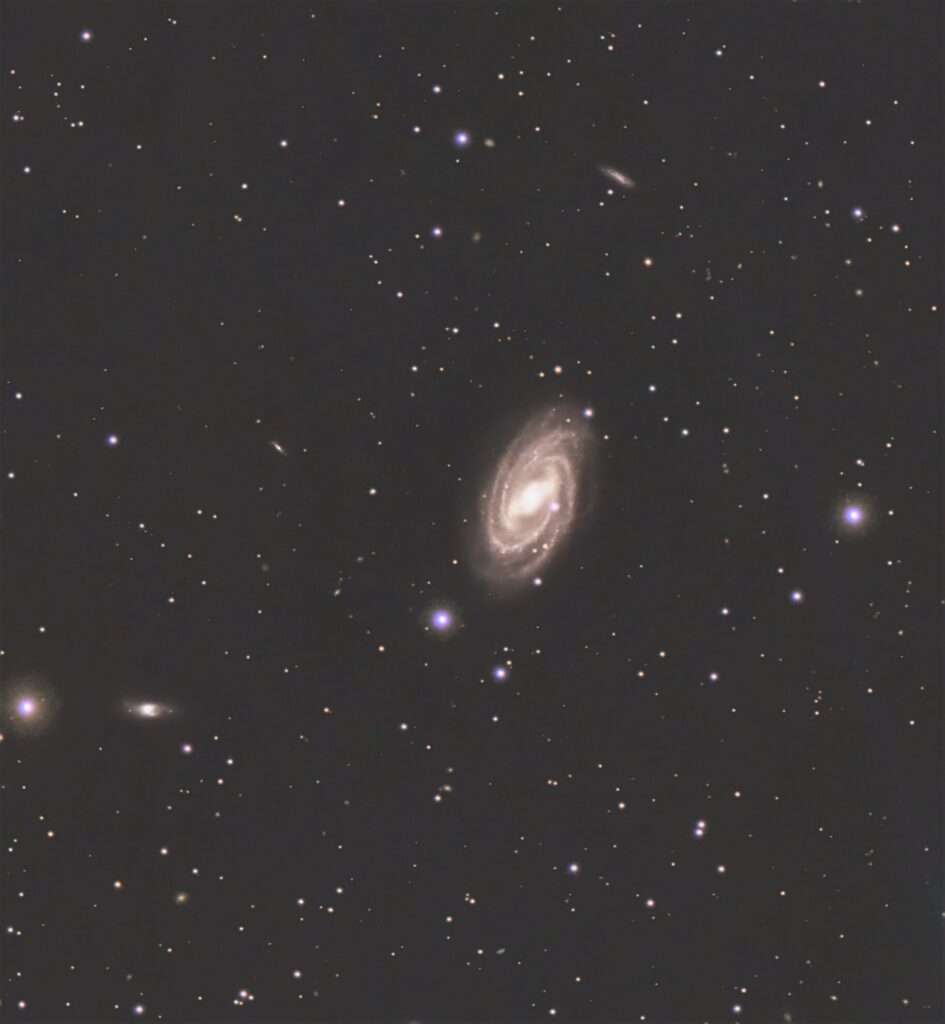
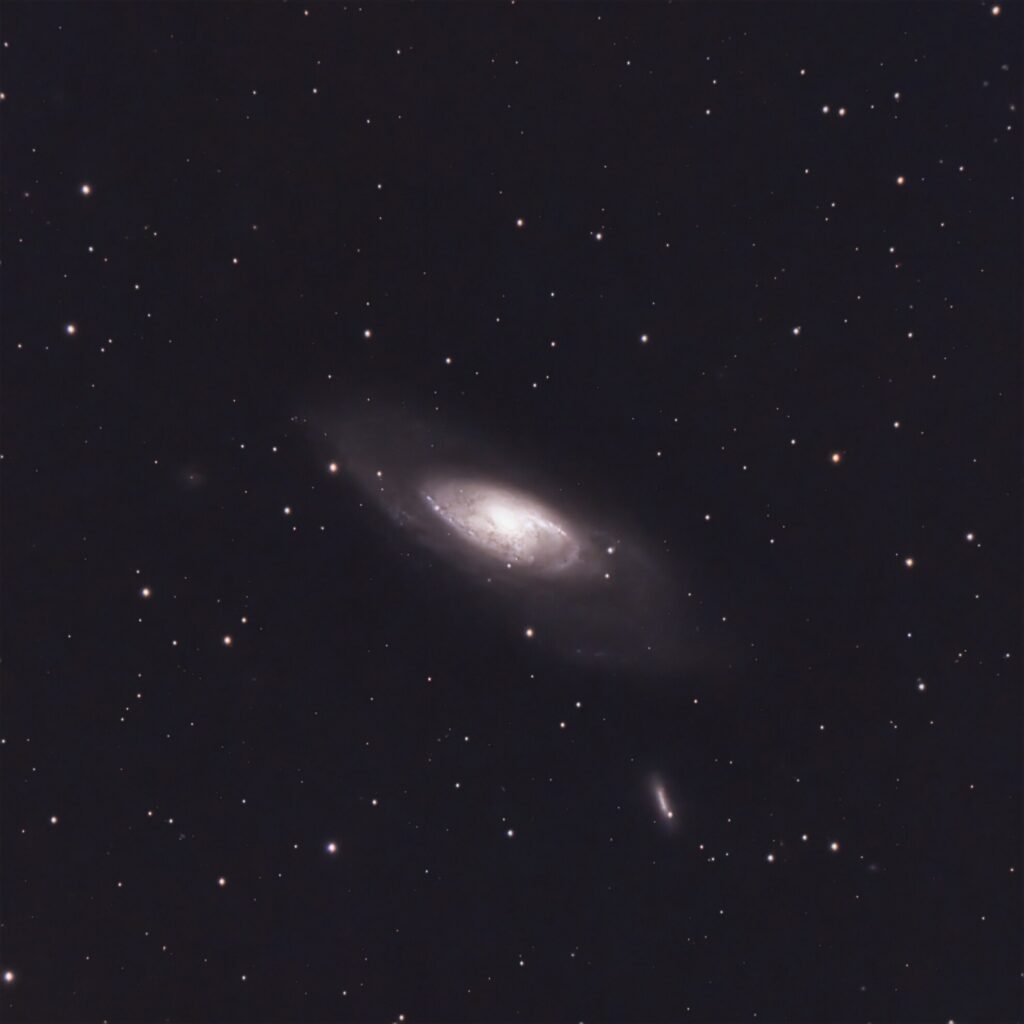
    M106

    Messier 106 (also known as NGC 4258) is an intermediate spiral galaxy in the constellation Canes Venatici. It was discovered by Pierre Méchain in 1781. M106 is at a distance of about 22 to 25 million light-years away from Earth. M106 contains an active nucleus classified as a Type 2 Seyfert, and the presence of a central supermassive black hole has been demonstrated from radio- wavelength observations of the rotation of a disk of molecular gas orbiting within the inner light-year around the black hole. NGC 4217 is a possible companion galaxy of Messier 106. Besides the two visible arms, it has two “anomalous arms” detectable using an X-ray telescope.

  • M104

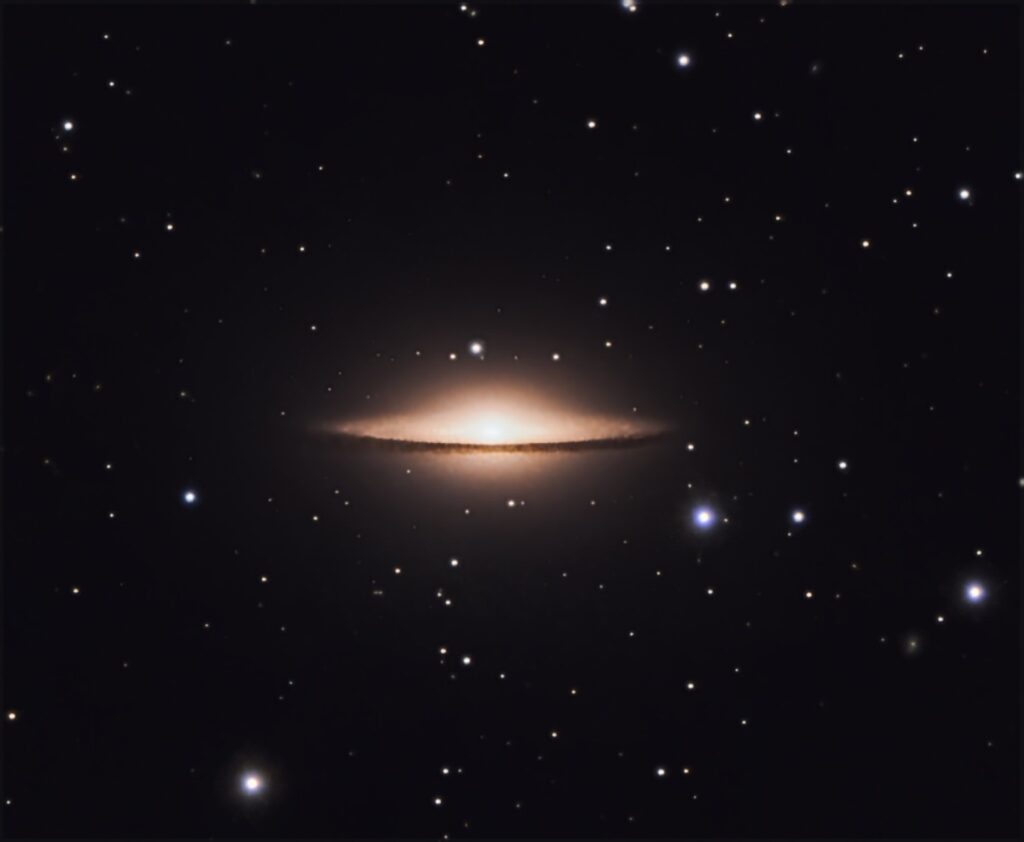
    M104 Sombrero Galaxy

    The Sombrero Galaxy (also known as Messier Object 104M104 or NGC 4594) is a peculiar galaxy of unclear classification in the constellation borders of Virgo and Corvus, being about 9.55 megaparsecs (31.1 million light-years) from the Milky Way galaxy. It is a member of the Virgo II Groups, a series of galaxies and galaxy clusters strung out from the southern edge of the Virgo Supercluster. It has an isophotal diameter of approximately 29.09 to 32.32 kiloparsecs (94,900 to 105,000 light-years), making it slightly larger than the Milky Way.

    It has a bright nucleus, an unusually large central bulge, and a prominent dust lane in its outer disk, which from Earth is viewed almost edge-on. The dark dust lane and the bulge give it the appearance of a sombrero hat. Astronomers initially thought the halo was small and light, indicative of a spiral galaxy; but the Spitzer Space Telescope found that the halo was significantly larger and more massive than previously thought, indicative of a giant elliptical galaxy.

    The galaxy has an apparent magnitude of +8.0, making it easily visible with amateur telescopes, and is considered by some authors to be the galaxy with the highest absolute magnitude within a radius of 10 megaparsecs of the Milky Way. Its large bulge, central supermassive black hole, and dust lane all attract the attention of professional astronomers.